


The history I-space,
 , is essentially the set
of all data the robots may ever obtain. Formally, for a time period
, is essentially the set
of all data the robots may ever obtain. Formally, for a time period
![$ [t_0, t_f] \subset T$](img128.gif) , a perfect description of everything that
occurred would be a state trajectory
, a perfect description of everything that
occurred would be a state trajectory
![$ \tilde{x}_t: [t_0, t_f]
\to X$](img129.gif) , in which
, in which  is the combined state space of robots and
targets. It is impossible to obtain this because not all target
positions are known. What is available is the robots' trajectory
is the combined state space of robots and
targets. It is impossible to obtain this because not all target
positions are known. What is available is the robots' trajectory
 and the sensor observation history
![$ \tilde{y}_t: [t_0, t_f] \to Y$](img132.gif) , produced by a sensor mapping
, produced by a sensor mapping
 , in which
  is the observation space of the sensors. That is,
 is a time-parameterized collection of sensor
observations. Let the robots also have access to some initial
information
is a time-parameterized collection of sensor
observations. Let the robots also have access to some initial
information  at
at  . The history I-state at time
 ,
,
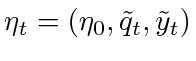 , represents all
information available to the robots. The history I-space
is the set of all possible history I-states.
, represents all
information available to the robots. The history I-space
is the set of all possible history I-states.
is an unwieldy space that must be greatly reduced if we
expect to solve interesting problems. Imagine a robot equipped with a
GPS and a video camera moves along some path  . Without a
specific task, the robot will not be able to decide what information
it gathers is useful; therefore, it has to store all of
. Without a
specific task, the robot will not be able to decide what information
it gathers is useful; therefore, it has to store all of
 . Even at a relatively low spatial resolution and a
frequency of 30 Hz, just keeping the robot's locations and the
camera's images in compressed form requires a large amount of storage
space, which presently is not generally possible over a long time
period.
. Even at a relatively low spatial resolution and a
frequency of 30 Hz, just keeping the robot's locations and the
camera's images in compressed form requires a large amount of storage
space, which presently is not generally possible over a long time
period.