


We conclude this section with the introduction of a shadow
sequence, of which the importance will become more apparent in
coming sections. When the shadows of
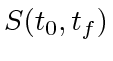 for a fixed path
 are put together, a sequential structure comes up. This
structure, which we call a shadow sequence, captures the combinatorial
changes of the labeled shadows through component events. A graphical
illustration of the shadow sequence for the example in
Fig. 1 is given in
Fig. 5.
are put together, a sequential structure comes up. This
structure, which we call a shadow sequence, captures the combinatorial
changes of the labeled shadows through component events. A graphical
illustration of the shadow sequence for the example in
Fig. 1 is given in
Fig. 5.
 |