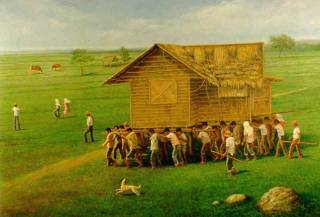
(painting by Joselito E. Barcelona, 1993)
Bayanihan Computing Group
Ateneo de Manila University
Philippines
Bayanihan is an old tradition in the Philippines wherein
neighbors
of a relocating family would help the family move by gathering under
their
house and carrying it to its new location.Although
bayanihan practiced
in this form has become rare in today’s modern times, the word
bayanihan
itself has come to mean any manifestation of the powerful spirit of
communal
unity that can make seemingly impossible feats possible through the
cooperation
of many people working towards a common goal.
The Bayanihan Computing Group seeks to bring the
bayanihan spirit
into the realm of computing by making it possible – and easy – for
people
to pool together their computing resources into a high-performance
computing
resource capable of solving computational problems much faster than
before.
Our work began in 1996 at the Massachusetts
Institute of Technology (MIT) as “Project
Bayanihan”, a doctoral thesis
project on the idea of
volunteer computing, a new form of computing
that makes it possible to form very large global networks of
cooperating
computers by making it very easy for even ordinary users on the
Internet
to volunteer their idle computers.Through Project Bayanihan, we
produced
several unique and new results, including a generic volunteer computing
framework using Java, new programming models and interfaces for
volunteer
computing, and several mechanisms for the new problem of sabotage-tolerance
– that is, the problem of producing correct results despite the
presence
of malicious volunteers submitting bad results. Today, we are
continuing
our research at the Ateneo de Manila
University in the Philippines, with Bayanihan
Computing .NET, a generic software framework that makes use of the
new technology of XML web services to go beyond the idea of
volunteer
computing to that of grid computing, wherein people can not
only
pool together their computing resources, but can now also make these
pooled
resources available to others through very simple programming
interfaces
called computational web services. Through the power of
web
services, Bayanihan Computing .NET not only allows people to even more
easily build volunteer computing systems than before, but more
importantly,
allows them to tap the computing power of these systems from
any
device – even PDAs and mobile phones. In this way, Bayanihan
Computing
.NET has the potential of bringing supercomputing power literally
into the hands of ordinary users.
What's New
Research Topics
Grid Computing
with
XML Web Services (Bayanihan Computing .NET)
- Bayanihan Computing .NET Student Project
- First Place, Microsoft Asia Student .NET Philippines
Competition,
September
2001, Manila, Philippines
- "Most Creative Solution" Award, Microsoft Asia Student .NET
Competition,
17 October 2001, Seoul, Korea
- Winner,
Worldwide Microsoft .NET Best Awards XML Web Services Contest, Academic
Category
- Overview Papers
- Technical Conference Paper
- Ph.D. Thesis
- Luis F. G. Sarmenta. Volunteer
Computing.
Ph.D. thesis. Dept. of Electrical Engineering and Computer Science,
MIT,
March 2001.
- Sabotage-Tolerance
(Protection Against Malicious Volunteers)
- Luis F. G. Sarmenta. Sabotage-Tolerance
Mechanisms for Volunteer Computing Systems. Future
Generation
Computer Systems, Vol. 18, Issue 4, Elsevier Publ., 2002 .
(Expanded
journal version of CCGrid ’01 Best Paper Finalist paper)
- Luis F. G. Sarmenta. Studying
Sabotage-Tolerance Mechanisms through Web-based Parallel Parametric
Analysis
and Monte Carlo Simulation. To appear in Internet Computing 2001
(in
PDPTA 2001 Multiconference), Las Vegas, Nevada, June 2001
- Luis F. G. Sarmenta. Sabotage-Tolerance
Mechanisms for Volunteer Computing Systems. ACM/IEEE
International
Symposium on Cluster Computing and the Grid (CCGrid'01), Brisbane,
Australia, May 15-18, 2001. (Best Paper Finalist)
- Luis F. G. Sarmenta. Protecting
Programs
from
Hostile Environments: Encrypted Computation, Obfuscation, and Other
Techniques.
Area Exam Paper, Dept. of Electrical Engineering and Computer Science,
MIT, July 1999. (Edited and published as an appendix in Volunteer
Computing)
- Programming Models and Interfaces for Volunteer Computing
Systems
- Volunteer Computing Systems
- Luis F. G. Sarmenta, Satoshi Hirano. Bayanihan:
Building and Studying Volunteer Computing Systems Using Java. To
appear
in Future Generation Computer Systems Special Issue on
Metacomputing,
Vol. 15, No. 5/6. Elsevier Publ., 1999.
- Luis F. G. Sarmenta, Satoshi Hirano, Stephen A. Ward. Towards
Bayanihan: Building an Extensible Framework for Volunteer Computing
Using
Java. ACM
1998
Workshop on Java for High-Performance Network Computing, Palo Alto,
California, Feb. 28 - Mar. 1, 1998. Published in Concurrency:
Practice
and Experience, Vol. 10(11-13), 1015-1019 (1998)
- Luis F. G. Sarmenta. Bayanihan:
Web-Based Volunteer Computing Using Java. Proc.
of the 2nd International Conference on World-Wide Computing and its
Applications
(WWCA'98), Tsukuba, Japan, March 3-4, 1998. Lecture Notes in
Computer
Science 1368, Springer-Verlag, 1998. pp. 444-461.
People
Project Leader
Luis F. G. Sarmenta, Ph.D.
(lfgs@admu.edu.ph)
Student Members
Stanley Tan
Sacha Chua
Paul Echevarria
Russell Santos
Joey Mendoza
Keywords: grid computing,
web
services, grid services, peer-to-peer computing, P2P computing,
volunteer
computing, distributed computing, parallel computing, metacomputing,
fault-tolerance
Page last updated: 7 August 2002