Abstract
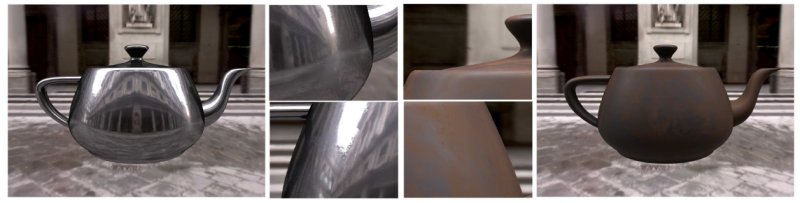
We present a generative model for isotropic bidirectional reflectance distribution functions (BRDFs) based on acquired reflectance data. Instead of using analytical reflectance models, we represent each BRDF as a dense set of measurements. This allows us to interpolate and extrapolate in the space of acquired BRDFs to create new BRDFs. We treat each acquired BRDF as a single high-dimensional vector taken from a space of all possible BRDFs. We apply both linear (subspace) and non-linear (manifold) dimensionality reduction tools in an effort to discover a lower dimensional representation that characterizes our measurements. We let users defne perceptually meaningful parametrization directions to navigate in the reduced-dimension BRDF space. On the low-dimensional manifold, movement along these directions produces novel but valid BRDFs.
Citation
Wojciech Matusik, Hanspeter Pfister, Matt Brand, and Leonard McMillan.
A Data-Driven Reflectance Model.
ACM Transactions on Graphics. 22(3) 2002.
Paper
Presentation