This is a collection of data and images on a project lead by Professor Bonnie Berger to study the mathematics of virus shell formation. The text is taken from a poster prepared for a demonstration of the simulator.
Nearly all previous research on interfering with the infection process has focused on how to prevent a fully-formed shell from binding to a cell. Our work aims at modeling how these shells build in the hopes of eventually suggesting ways of interfering with their growth and causing deformity. If this can be achieved, the genomic information won't fit inside the shell, and the virus won't be viable.
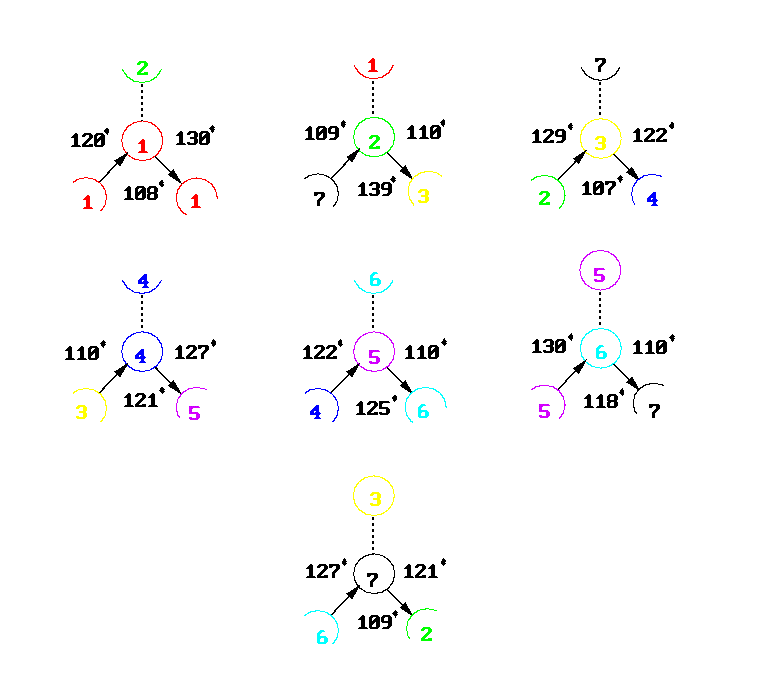
We have developed a hypothesis as to how virus shells form based solely on simple local rules for how proteins interact. We model virus shells as an interconnection network of proteins (i.e. nodes) and their essential binding interactions (i.e. edges). Chemically speaking, the nodes or proteins are usually all identical: however, they can be thought to behave differently because proteins can take on different shapes. We have shown that by utilizing only local communication, each node in the network can be given enough information to uniquely form any size shell. This information consists of the type of a node and its neighbors, bond angles, bond lengths, and torsional angles.
We have used our theory to develop a computer toolkit to model virus shell assembly. The toolkit has been implemented on both the SGI and CM-5. The CM-5 is a factor of 14 faster than the SGI.
We have used the toolkit to explore the tolerance margins of shells as well as possible deformities. The implementation relies upon an optimizer that is based on a simple spring model. We have discovered that the angles and bond lengths can be varied up to 8% randomly, and the shell still closes. When angles and lengths are so varied, roughly the same shell is produced, but the program has to work much harder. Greater variations result in serious deformities, however. For example, the local rule theory tells us that if a hexamer occurs in place of an initial pentamer, spiraling occurs. This has been verified computationally.
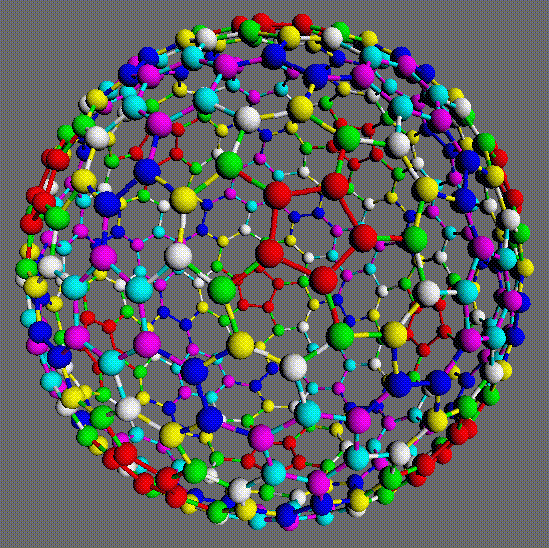
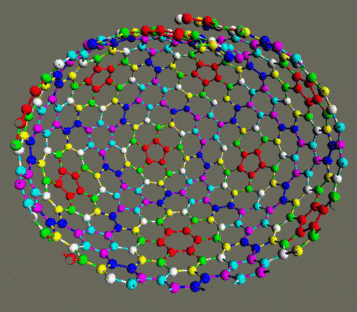
Click here to see the local rules for a T=7 shell.
Peter Shor
Jonathan King
Doug Muir
Russell Schwartz
Lisa Tucker-Kellogg
Email bab@theory.lcs.mit.edu