|
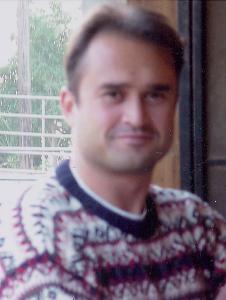
Deniz Yuret
Assistant Professor of Computer Engineering Koc University Rumeli Feneri Yolu 80910 Sariyer, Istanbul, Turkey Tel: +90 (212) 338-1724 Fax: +90 (212) 338-1548 E-Mail: dyuret@ku.edu.tr Homepage: http://home.ku.edu.tr/~dyuret |
||
Department of Electrical Engineering and Computer Science
Postdoctoral Research Associate
Doctor of Philosophy in Computer Science
Master of Science in Electrical Engineering and Computer Science
Bachelor of Science in Electrical Engineering
Numerical Optimization
Computational Economics and Finance
Other
Mobile Robotics: Worked in the mobile robot group of Rodney Brooks designing the TV circuitry for the robot Atilla. Atilla was a precursor of Sojourner, the robot NASA sent to Mars in 1997.
Computer Chess: Worked with David McAllester developing the ABC-Search chess algorithm. The world champion chess program Socrates used some of our techniques successfully.
Honors
- Boris Katz, Deniz Yuret, et al. (1999)
- Integrating Large Lexicons and Web Resources into a Natural Language Query System. Proceedings of the IEEE International Conference on Multimedia Computing and Systems.
- Ozlem Uzuner, Boris Katz, Deniz Yuret (1999)
- Word sense disambiguation for information retrieval. In Proceedings of the 1999 16th National Conference on Artificial Intelligence (AAAI-99)
- Deniz Yuret (1998)
- Discovery of Linguistic Relations Using Lexical Attraction, PhD thesis, MIT.
- Boris Katz, Deniz Yuret, et al. (1998)
- Blitz: A Preprocessor for Detecting Context-Independent Linguistic Structures. In Proceedings of the 5th Pacific Rim International Conference on Artificial Intelligence.
- Michael de la Maza and Deniz Yuret (1995)
- Seeing clearly: Medical imaging now and tomorrow. In Clifford A. Pickover, editor, Future Health: Computers and Medicine in the 21st Century. St. Martin's Press.
- Deniz Yuret (1994)
- From genetic algorithms to efficient optimization. Technical Report 1569, MIT AI Laboratory.
- Michael de la Maza and Deniz Yuret (1994)
- Dynamic hill climbing. AI Expert.
- Deniz Yuret and Michael de la Maza (1993)
- Dynamic hill climbing: Overcoming the limitations of optimization techniques. In The Second Turkish Symposium on Artificial Intelligence and Neural Networks.
- Ayla Ogus, Michael de la Maza, and Deniz Yuret (1999)
- Modeling the Economics of Internet Companies. Computing in Economics and Finance, Proceedings of the Fifth International Conference of the Society for Computational Economics.
- Michael de la Maza, Ayla Ogus, and Deniz Yuret (1998)
- How do firms transition between monopoly and competitive behavior? An Agent-based Economic Model. In Proceedings of the Sixth International Conference on Artificial Life.
- Michael de la Maza and Deniz Yuret (1995)
- A model of stock market participants. In Jörg Biethahn and Volker Nissen, editors, Evolutionary Algorithms in Management Applications. Springer.
- Michael de la Maza and Deniz Yuret (1995)
- Neural network applications: A critique. The Magazine of Artificial Intelligence in Finance, 2(1).
- Michael de la Maza and Deniz Yuret (1994)
- A futures market simulation with non-rational participants. In Rodney A. Brooks and Pattie Maes, editors, Proceedings of the Fourth International Workshop on the Synthesis and Simulation of Living Systems.
- Deniz Yuret and Michael de la Maza (1994)
- A genetic algorithm system for predicting the OEX. Technical Analysis of Stocks & Commodities.
- Michael de la Maza and Deniz Yuret (1994)
- Experimenting with a market simulation. The Magazine of Artificial Intelligence in Finance, 1(3).
- David McAllester and Deniz Yuret (2002)
- Alpha-beta-conspiracy search. ICGA Journal, Vol. 25, No. 2, pp. 16--35
- Deniz Yuret (1994)
- The principle of pressure in chess. In The Third Turkish Symposium on Artificial Intelligence and Neural Networks.
Rodney Brooks, Fujitsu Professor of Computer Science and Engineering, Director of the MIT Artificial Intelligence Laboratory. Address: 545 Technology Square, NE43-940, Cambridge, MA 02139, USA. Telephone: 1-617-253-5223. Fax: 1-617-253-0039. Email: brooks@ai.mit.edu.
Boris Katz, Principal Research Scientist, MIT Artificial Intelligence Laboratory. Address: 545 Technology Square, NE43-824, Cambridge, MA 02139, USA. Telephone: 1-617-253-6032. Fax: 1-617-258-7413. Email: boris@ai.mit.edu.