6.S050: Syntax
Created: 2023-05-11 Thu 11:06
What is syntax?
- Rules that define which strings correspond to programs.
- A description of the structure of programs.
What we will cover
- Existing syntax designs—what options do you have as a designer?
- How should we specify syntax?
- Pitfalls to avoid
Syntax design in the wild: Python
def factorial(n):
  if n == 0:
    return 1
  return n * factorial(n - 1)
Syntax design in the wild: C
int factorial(int n) {
  return n == 0 ? 1 : n * factorial(n - 1);
}
Syntax design in the wild
Syntax design principles
- Consistency
- Compositionality
- Concision
Consistency
- External: when possible, use syntax that users already know
- Example: use
x[0], notx.(0)for indexing strings - Copying other languages reduces surprises
- Example: use
- Internal: similar operations should look similar
- Example: Ocaml has two assignment operators depending on the type of the
left-hand-side:
x := 1andx.f <- 1
- Example: Ocaml has two assignment operators depending on the type of the
left-hand-side:
Compositionality
- The meaning of a phrase should be determined by the meaning of the individual
parts and the method of composition
- Frege's principle
- C++
type<arg>type<type<arg>>- also have bitwise operator
>> - so is
>>an operator, or is it part of a template?- early C++ required a space
> >in the template case
- early C++ required a space
Concision
- Shorter programs are (often) better than longer ones
- Make common operations easy to write
- Unwrap operator
maybe_fails(34)?
match maybe_fails(34) {
Ok (x) => x,
Err(e) => return Err(e)
}
Why not "Simplicity"
- Languages should have few "basic concepts"
- Lisp
(let ((a + 1 (* 2 3))) (/ a 2))let a = 1 + 2 * 3; a / 2
- Not clear that this kind of simplicity is helpful
Design principles in practice
Problem of syntax
Text -> Lexical structure -> Syntactic structure -> Abstract syntax
Concrete & abstract syntax
- Concrete: reflects the representation of the program as text
- Abstract: throws away textual details; represents only the program
Kinds of syntax specification
- Natural language
- Context-free grammar (variety of notations)
- Implementation
Grammars by example
Consider a language that has:
- Functions
- If-then-else
- Arithmetic
def factorial(n) {
  if (n == 0) then
    return 1;
  else
    return n * factorial(n - 1);
}

print(factorial(5));
Let's walk through a grammar for this language.
Terminology
- Identifier: a name defined in the program
- Keyword: a word used to define program structure
- Statement: performs an action with a side effect
Expression: compute a value
Lexing
- Earlier we said that languages have lexical and syntactic structure
- This grammar mixes both
- Split grammar into
- Lexical rules
- Phrase rules
- Practical benefits
- Simplicity (our grammar ignores whitespace!)
- Performance
Pitfalls
Ambiguity
- Multiple parse trees for a string
- "John saw the man on the mountain with a telescope."
- BBC headline: "Knife crime: St John Ambulance to teach teens to help stab victims"
Atlantic headline: "Susan Collins Unveils a Gun-Control Compromise: It would restrict sales to individuals on two terrorist watch lists"
Ambiguity
How should we parse 2 * x + y?
Ambiguity
- No general strategy for eliminating ambiguity
- Even detecting it is undecidable
- Can cover some common cases
- Precedence
- Associativity
- Dangling else
Precedence & associativity
- Common problem in expression grammars
<expr> ::= <id> | <expr> ("-" | "*") <expr> | "(" <expr> ")"
Precedence & associativity
How to parse x - y - z * z?
Precedence & associativity
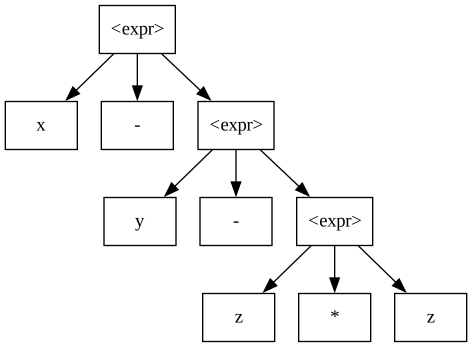
Precedence & associativity
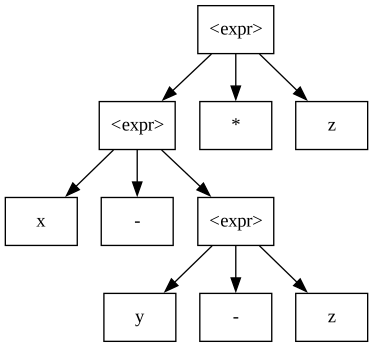
Precedence
How can we force x - y - z * z to parse as:
(x - y) - (z * z)
Precedence
<expr> ::= <expr> "-" <expr> | <expr1>
<expr1> ::= <expr1> "*" <expr1> | <expr2>
<expr2> ::= <id> | "(" <expr> ")"
Associativity
<expr> ::= <expr> "-" <expr1> | <expr1>
<expr1> ::= <expr1> "*" <expr2> | <expr2>
<expr2> ::= <id> | "(" <expr> ")"