


So far we have assumed that shadows and events are always reported without any error, which is unrealistic in practice. For detecting shadows, we already mentioned that true sensing range may be unavailable for some sensors and sometimes it is simply computationally impractical to obtain the exact visible/shadow region. However, if we settle for partial correctness, then probabilistic models can be applied. For example, when we deal with sensor networks, conservative, probabilistic estimates of sensing range may suffice.
The same principle applies to FOV events. For each of the three FOV
events, we assume that the sensors on the robots may correctly observe
it or mistake it for the other two events. An enter event for a
component may be reported by the sensor as an enter, exit, or null
event; same applies to exit and null events. That is, the sensor
mapping is given by
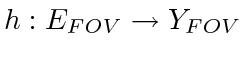 , with
  being the
set of field-of-view observations
being the
set of field-of-view observations
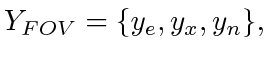
in which
 and
and  are enter, exit, and null observations. The map
  can be deterministic, nondeterministic, or probabilistic. Further details on modeling imperfect sensors will be discussed when specific tasks are handled.