


 |
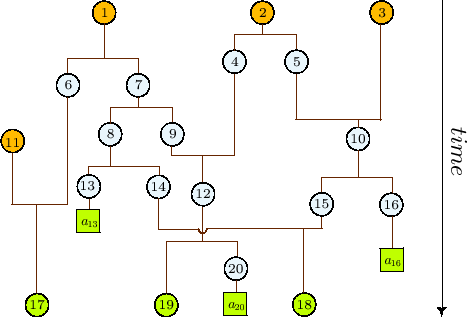
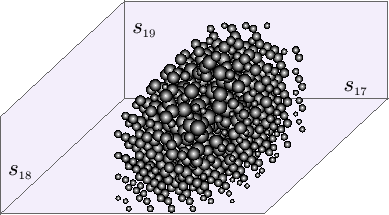
For the probabilistic case, we ran a simulation with the observation
sequence in Fig. 16. The sequence contains  component event observations. We also included
  FOV events
scattered along the sequence, which are not marked in the
figure. Shadows
FOV events
scattered along the sequence, which are not marked in the
figure. Shadows
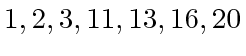 are associated with
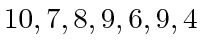 targets (with probability
  ), respectively. For
performance measures, we look at the time for one run of the algorithm
to complete, as well as the expectation (mean and standard deviation
for randomized methods) of targets in individual shadows at the end
(
), respectively. For
performance measures, we look at the time for one run of the algorithm
to complete, as well as the expectation (mean and standard deviation
for randomized methods) of targets in individual shadows at the end
(
 , and
, and  ). When we randomly pick entries to
keep, the time result is averaged over
). When we randomly pick entries to
keep, the time result is averaged over  runs and the accuracy is
given in the form of mean and standard deviation. In our implementation, we
also make the following choices: 1) for random truncation, the entries
are kept based on its probability multiplied with a random number in
runs and the accuracy is
given in the form of mean and standard deviation. In our implementation, we
also make the following choices: 1) for random truncation, the entries
are kept based on its probability multiplied with a random number in
 , 2) for event lookahead, we will not truncate the entries if
there is a disappear event within the next four events or a merge
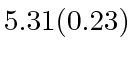
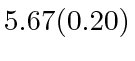
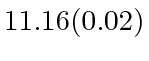
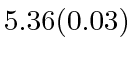
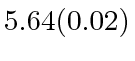
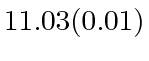
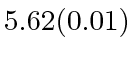
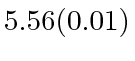
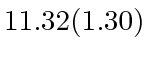
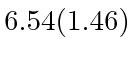
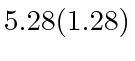
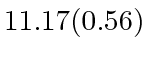
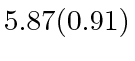
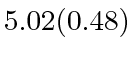
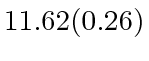
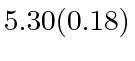
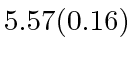
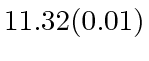
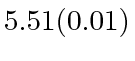
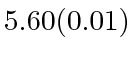
event within the next two events. The outcome is summarized in Table
VI. The heuristics basic truncation, random
truncation, and random truncation with event lookahead are shortened
as TR, RT, and RT-LA, respectively. The number following the method is
the number of entries kept. By frequent failure, we mean that
more than
, 2) for event lookahead, we will not truncate the entries if
there is a disappear event within the next four events or a merge
event within the next two events. The outcome is summarized in Table
VI. The heuristics basic truncation, random
truncation, and random truncation with event lookahead are shortened
as TR, RT, and RT-LA, respectively. The number following the method is
the number of entries kept. By frequent failure, we mean that
more than  of the times the heuristic fails to give a valid
result. These are indicative of minimum number of entries needed for
the method to work.
of the times the heuristic fails to give a valid
result. These are indicative of minimum number of entries needed for
the method to work.
| heuristic | 
|

|
|
t(s) |
| none, precise | 
|

|

|
329.5 |
| TR-10000 | failure | |||
| TR-20000 | 
|

|

|
6.1 |
| TR-50000 | 
|

|

|
15.5 |
| TR-100000 | 
|

|

|
29.4 |
| TR-200000 | 
|

|

|
61.4 |
| RT-10000 | frequent failure | |||
| RT-20000 |
|
|
|
6.1 |
| RT-50000 |
|
|
|
14.6 |
| RT-100000 |
|
|
|
28.3 |
| RT-LA-2000 | frequent failure | |||
| RT-LA-5000 |
|
|
|
2.0 |
| RT-LA-10000 |
|
|
|
4.2 |
| RT-LA-20000 |
|
|
|
8.3 |
| RT-LA-50000 |
|
|
|
17.7 |
| Monte Carlo | 
|

|

|
42.1 |
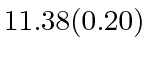
The result shows that when no heuristic is used, the algorithm takes much more time to finish. This is not surprising since the time complexity is induced by the space requirement for storing the probability mass entries. On the other hand, all of the truncation heuristics work reasonably well, with the randomized truncation plus event lookahead greatly reduces the number of entries to retain. The RT-LA-50000 run compares well with the TR-100000 run on accuracy, but uses one third less time. We expect the advantage to become more obvious as more targets are present in the system. The final target distribution from one RT-100000 run is given in figure 17.
 |
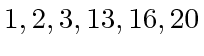 to
to
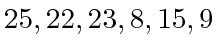 , while leaving other
observations unchanged. With the increased number of targets, the
basic algorithm runs out of memory after
minutes, before the
third split is completed. At the peak of its memory usage during the
failed run, there are more than
, while leaving other
observations unchanged. With the increased number of targets, the
basic algorithm runs out of memory after
minutes, before the
third split is completed. At the peak of its memory usage during the
failed run, there are more than
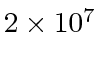 probability mass
entries. On the other hand, it is not a problem for the the randomized
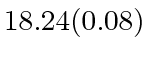
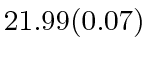
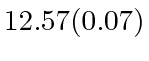
methods: Both RT-100000 RT-LA-50000 yield good results compared to
Monte Carlo trials, with similar running time. The result is
summarized in Table VII.
probability mass
entries. On the other hand, it is not a problem for the the randomized
methods: Both RT-100000 RT-LA-50000 yield good results compared to
Monte Carlo trials, with similar running time. The result is
summarized in Table VII.
| Heuristic |
|
|
|
t(s) |
| none, exact | out of memory after
mins |
|||
| Monte Carlo | 
|

|

|
43.2 |
| RT-100000 | 
|

|

|
66.3 |
| RT-LA-50000 |
|
|
|
40.6 |
Comprehensive performance analysis of probabilistic algorithm is hard
since the performance depends on external factors such as the
implementation of the specific split rule, random number generator,
and so on. Nevertheless, for completeness, we discuss the performance
at a higher level. To avoid the issue of external factors, we assume
that at each step, each probability mass takes constant time to
process. Unlike the nondeterministic case, running time of the
 algorithm may depend heavily on the
number of targets in the system via the split rule. If there are
algorithm may depend heavily on the
number of targets in the system via the split rule. If there are  split events with an average number of targets in the originating
shadow being
split events with an average number of targets in the originating
shadow being  and also
  FOV events, with the reasonable
additional assumption that merge, appear, and disappear events are on
the same order as split events, the
algorithm can take time
FOV events, with the reasonable
additional assumption that merge, appear, and disappear events are on
the same order as split events, the
algorithm can take time
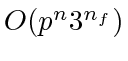 . The running time of the
resampling based algorithms has a big constant depending on the number
of entries to keep, but otherwise depends only linearly on the number
of critical events.
. The running time of the
resampling based algorithms has a big constant depending on the number
of entries to keep, but otherwise depends only linearly on the number
of critical events.
 shadows in its life cycle. The field of view observations are not marked.