


Let a nonempty set of robots move along continuous trajectories in a
workspace,
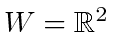 or
or
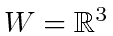 . Let the configuration
space of the robots be
. Let the configuration
space of the robots be
 . At some time
  , there may be
configuration space obstacles
, there may be
configuration space obstacles
 , leaving
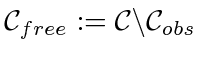 as the free
configuration space. Let
as the free
configuration space. Let
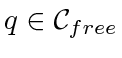 be the
configuration of the robots. Returning to workspace, there is a closed
obstacle region
be the
configuration of the robots. Returning to workspace, there is a closed
obstacle region
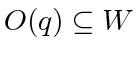 , leaving
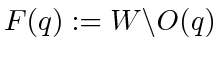 as the free space. The robots are equipped with
sensors that allow them to make shared observations in a joint field-of-view (FOV) or visible region
as the free space. The robots are equipped with
sensors that allow them to make shared observations in a joint field-of-view (FOV) or visible region
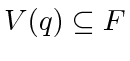 . For
convenience, we take the closure of
. For
convenience, we take the closure of  and assume that the visible
region is always closed. Let
and assume that the visible
region is always closed. Let
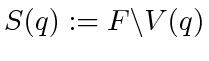 be the shadow region, which may contain zero or more nonempty path
connected components (path components for short). A path component is
assumed to be nonempty unless otherwise specified. At any instant,
be the shadow region, which may contain zero or more nonempty path
connected components (path components for short). A path component is
assumed to be nonempty unless otherwise specified. At any instant,
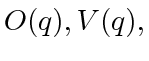 and
and  have disjoint interiors by definition and
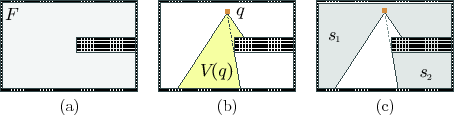
 . Fig. 3 shows
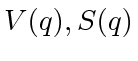 for a point robot holding a flashlight in
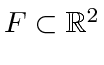 ,
,
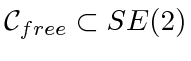 .
.
 |
To observe how path components of the shadow region evolve over time,
let the robots follow some path
![$ \tau: [t_0, t_f] \to \mathcal C$](img53.gif) in
which
in
which
![$ [t_0, t_f] \subseteq T \subset \mathbb{R}$](img54.gif) is a time interval. Let
is a time interval. Let
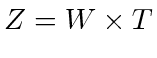 . Since obstacles may vary over configuration and time,
let
. Since obstacles may vary over configuration and time,
let
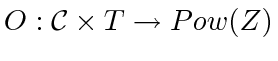
be the map that yields the obstacle region with a time stamp attached. We may also view
 as varying over configuration and time:

Since a path
 , parameterized over
  , is always assumed
in the paper, we abusively write
, is always assumed
in the paper, we abusively write
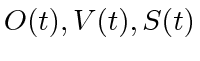 in place of
 , respectively. For any
interval
, respectively. For any
interval
![$ (t_a, t_b) \subset [t_0, t_f]$](img63.gif) , let
, let
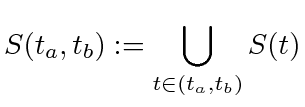
be called a slab, which is an open subset of
 . For any subset
  of
, define its projection onto the time axis as
of
, define its projection onto the time axis as
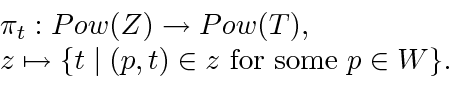
Let
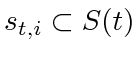 denote the
  -th path component of
  . Let
. Let  denote the
  -th path component of a slab
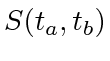 .
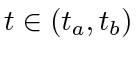
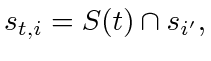
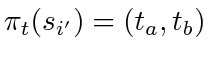
is homogeneous if for all
.
is homogeneous if for all
 and all
for each
, there exists
such that
and all
for each
, there exists
such that
and separately,
 for all
A homogeneous slab is called maximal if it is not a proper subset of another homogeneous slab. The definition then partitions
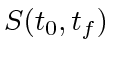 into some
  disjoint maximally homogeneous slabs plus some slices

That is, homogeneity of
is broken at
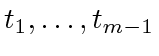 . What exactly happens at
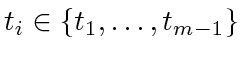 ? Let there be two homogeneous slabs
and
? Let there be two homogeneous slabs
and
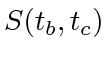 such that
 for some
. Let
for some
. Let  be an arbitrary path component of
, at
be an arbitrary path component of
, at  ,
may (
,
may (
 denotes the closure of
  )
)
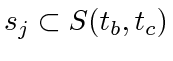 such that
 .
.
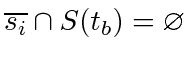 .
may
.
may
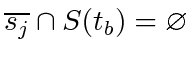 .
.
 of
may
of
may
 of
such that
of
such that
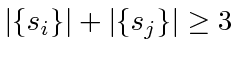 and
and
 is a single path component of
  .
.
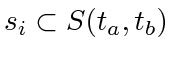 is called homogeneous if no component events happen to a subset of
in
is called homogeneous if no component events happen to a subset of
in
 ;
is called maximal if it is not a proper
subset of another homogeneous path component.
;
is called maximal if it is not a proper
subset of another homogeneous path component.
In this paper, a type of general position is
assumed to avoid two cumbersome cases: 1) Four or more path components
cannot be involved in an evolve event, and 2) Two or more component
events cannot occur at the same time. With such an assumption, exactly
one component event happens between two maximally homogeneous
slabs. Moreover, the evolve event can be divided into two sub events:
split if
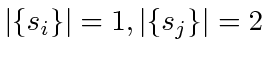 and merge if
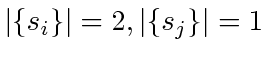 . The appear, disappear, split and merge events, as they happen in
, are illustrated in
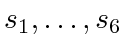
Fig. 2: For the slab
, there are two shaded
path components, five maximally homogeneous slabs (between dotted
vertical lines), and six maximally homogeneous path components
. The appear, disappear, split and merge events, as they happen in
, are illustrated in
Fig. 2: For the slab
, there are two shaded
path components, five maximally homogeneous slabs (between dotted
vertical lines), and six maximally homogeneous path components
 . Each vertical slice along
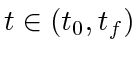 corresponds
to
. There are four component events. For convenience, it is
assumed that
corresponds
to
. There are four component events. For convenience, it is
assumed that  is not a critical time in the sense that for
each path component
is not a critical time in the sense that for
each path component
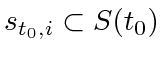 ,
,
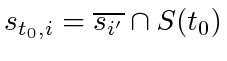 for some path component
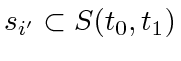 . A similar assumption is made for
  .
.
It is easy to see that
maximally homogeneous path components are pairwise disjoint. Let such
a path component be called a shadow component. Let
be
the set of shadow components of
; note that
is contained in the closure of
 . For some
, let a path component of
be labeled as
. For some
, let a path component of
be labeled as  if it is
a slice (cross section) of a shadow component
. More precisely,
if it is
a slice (cross section) of a shadow component
. More precisely,
 . For
,
. For
,
 is labeled such if
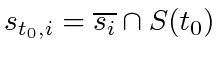 for
some path component
for
some path component
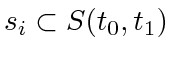 . Same applies to the
labeling of
. Same applies to the
labeling of
 . A path component of
has no label
exactly when it is the border of two or more shadow components of a
slab. Since such labeling is unique, we drop time subscript of
if
is fixed. In the rest of the paper, we use the set
to denote both shadow components and slices of shadow
components; we simply call both types of path components shadows
when no confusion will arise from the context. When we do need to
distinguish, the former will be called workspace-time shadows
and the later workspace shadows.
. A path component of
has no label
exactly when it is the border of two or more shadow components of a
slab. Since such labeling is unique, we drop time subscript of
if
is fixed. In the rest of the paper, we use the set
to denote both shadow components and slices of shadow
components; we simply call both types of path components shadows
when no confusion will arise from the context. When we do need to
distinguish, the former will be called workspace-time shadows
and the later workspace shadows.
 . (b) The visible region. (c) The shadow region with two path components
  .
.