
 Research
The Genesis Group
 |
To better understand our intelligence in general, and our keystone story understanding competence in particular, my students and I formed The Genesis Group. You can find detailed descriptions of what we do at the Genesis page and learn more about why we do it in Moonshot, below.
Genesis plays the Globe
 |
Yes, Genesis is playing in the Globe today, the Boston Globe that is, not the London Theater.
3 June 2018
Moon Shot
 |
Copernicus taught us about the solar system. Darwin did the same for evolution. Then, Watson and Crick determined the structure of DNA. Collectively they answered fundamental questions about who we are. Now, we can realistically dream of another scientific achievement of equal importance: constructing a top-to-bottom, computational account of our own intelligence.
My students and I want to do it now because we are curious, because the problems are hard, because the problems are exciting, and because we need a better understanding of ourselves and each other and the forces that make us what we are.
We need to do it now because the scientific answers will revolutionize the engineering of intelligent systems. Applications with humanlike intelligence will emerge and empower in education, health care, policy development, business, energy, the environment, cybersecurity, and all the other high-impact areas with unsolvable problems that we must solve.
We can to do it now because we are asking better questions; because computer power is now effectively unlimited; because of encouraging progress in the contributing fields; because of maturing techniques for studying the neural substrate; and because there is immense student interest.
Our better questions include: How are we different from other species? And what are the competences we share with other species such that the difference matters.
Our answer is that we do, in fact, have a differentiating, keystone competence: we build complex, highly nested symbolic descriptions of situations and events. Together with the competences we share with other species, the keystone competence enables story telling, story understanding, and story composition, and all that enables much, perhaps most, perhaps all of education.
We may be wasting our time, of course, but the potential reward is that 1,000 years from now, everyone could say that we first understood our own intelligence.
Will they take over
 |
Links to WCVB TV Chronical show devoted to concerns about the future of AI, first aired 2 March 2016.
The Genesis Group is part of MIT's Computer Science and Artificial Intelligence Laboratory.


Members of the Genesis Group particpate in MIT's Center for Brains, Minds, and Machines, sponsored by the National Science Foundation.
The center is dedicated to developing a deep understanding of intelligence and the ability to engineer it, ephasizing how it works, how it develops in childhood, how it is implemented in neurobiology, and how it is amplified through social interaction.
The Center for Brains Minds and Machines emerged from I2, MIT's Intelligence Initiative, a campus wide effort initiated by Marc Kastner, Dean of MIT's School of Science, aimed at developing a broad scientific understanding of the brain and human intelligence.

Copyright © 2018 Patrick Henry Winston
This site was updated on
25 March 2019
Designer: Chiai Takahashi
Teaching
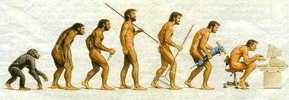
In the fall, I teach 6.034, Introduction to Artificial Intelligence, a large class.
Grades are calculated in accord with several student-oriented principles. For example, because we want to encourage each student to compete with himself/herself and not with each other, we no longer compute a class average. Because anyone can have a bad day, each segment of the material is tested both in a quiz and on the final, and we only count the higher grade.
We who teach the subject are pleased to note that grades are correlated with attendance at lectures, quiz reviews, recitations, and tutorials.
Anticipating a shift of skill building to the on-line world, we have enriched the subject with what we call Right-now Talks, aimed at exposing exciting, up-to-the-minute research occuring at MIT.
In the spring, I teach 6.xxx (also known as 6.803 and 6.833), The Human Intelligence Enterprise, a class in which I focus on contributions that visionary thinkers have made toward developing a computational explanation of intelligence.
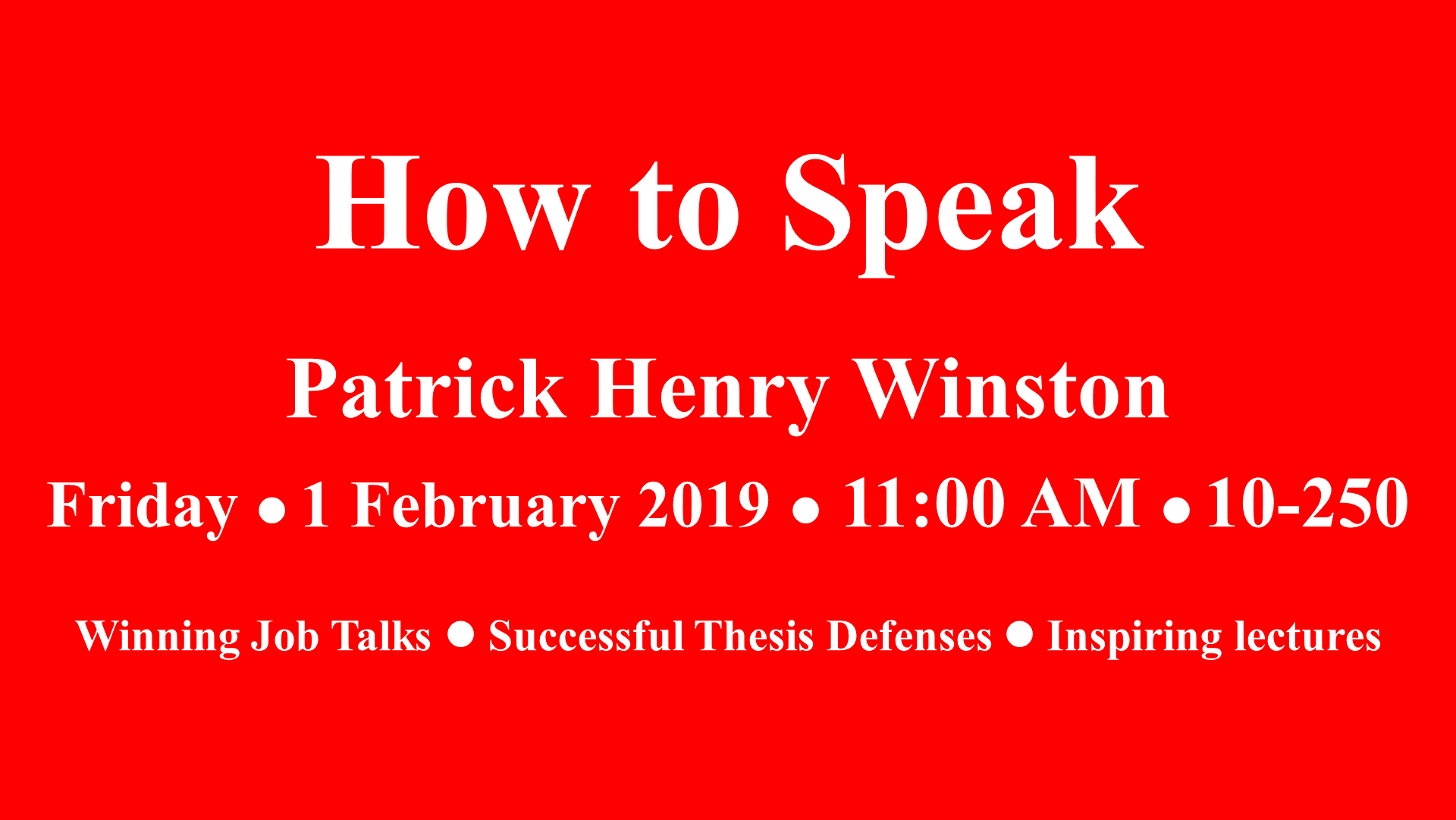
During the Independent Activities period, I talk on the subject of How To Speak. The talk helps people do a better job in lectures, theses defenses, and job talks.
Awards
All of us involved in developing and teaching 6.034 and 6.xxx over the years are immensely pleased that our work on these subjects has been appreciated by students. Our collective efforts led to the 2011 Eta Kappa Nu Teaching Award for excellence in instruction, a MacVicar Faculty Fellowship in 2011, the Baker Award for undergraduate teaching in 2010, and the Graduate Student Council Teaching Award in 2006. Unknown, but heroic students went to a lot of trouble to make it happen.
We were also pleased to note that, according to a Bloomberg article, 6.034 is among Five of the Best Computer Science Classes in the U.S. Of course, what they meant to say was that 6.034 has had graduate-student teaching assistants that are consistently outstanding.