|


Sponsored by The Ladies of Refined Taste & Friends
and Minute Man National Historical Park
Here we behold a hat, there a bonnet…*
by Sue Felshin
Last modified 1 Jan 2012
Copyright © 2008–2011 Sue Felshin, All Rights Reserved
Contents
- What is a bonnet?
- History
- Use
- Design Features
- Size | Brim shape | Caul shape | Color | Materials | Trim | strings
- Safety Note
- Documentation
Women, are you tired of wearing a straw hat everywhere you go? Let's look at an alternative: the bonnet. While not as commonly worn as straw hats, we find bonnets just as widely worn, by women of every class and in plain and fancy styles. A bonnet is warmer than a hat, especially in rain or snow, and there's nothing like it for keeping your cloak hood in place. Depending on the shape, it may be better than a hat at keeping the sun out of your eyes. On the other hand, a bonnet can be unpleasant on a hot day, it restricts your view more than a hat does, and depending on the style, it restricts your hearing as well—maybe that's why we find that although bonnets were quite common in the 18th century, they didn't have the ubiquity of straw hats.
What is a bonnet?
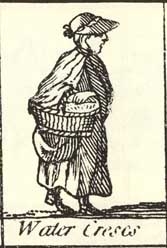
While an exact definition remains elusive, in general we may say that an 18th century bonnet is an item of headwear consisting of two parts, a soft caul and a stiff brim which is wider toward the front than the back (and frequently narrowing to nothing at all in back). Although size and shape varied, the most common sort of bonnet was like the one shown here in Catchpenny #196 (Water Cress), with a smallish caul and with a slightly downward pointing brim of a moderate size that blocks the sun in front and covers the ears about halfway at the sides.
History
Bonnets start to gain in popularity just as hoods become less common. That's not too surprising since the two types of headgear have much in common in terms of being warm and providing protection from bad weather. (These “hoods” were detached hoods, possibly with capes but not connected to cloaks.) While there are some very rare earlier examples (most of which appear to have been made of straw), bonnets don't appear in notable quantity until the 1760s. By the 1770s, they're all over the place. Although the fashionable shape changes over time, bonnets remain popular for another century.
Use
Documentation shows that women wore bonnets in largely the same circumstances as hats: mostly outdoors, for protection from the elements. As with a hat, a bonnet was typically worn over a cap. Experimental archaeology (also known as “trying and seeing”) reveals that bonnets have one particular feature that hats don't have: Because they have no brim in back, you can wear a bonnet under the hood of a cloak. The bonnet holds the hood in place. It keeps it from falling backward off your head or forward over your eyes. Has it ever driven you crazy that when you wear a cloak with a hood, and you turn your head, the hood stays put and you find yourself looking at the inside of the hood? Well, when you wear a bonnet under a hood, it makes the hood turn with your head and the bonnet. It's very handy!
Design Features
Size
The typical RevWar bonnet is fairly small compared to Regency and Civil War era bonnets, but size does range a fair amount. Commonly, the brim covers about half the ear. See the safety note, below! Pre-1770s bonnets are rare enough that I can't comment on design features other than that they seem about the same as 1770s.
Brim shape:
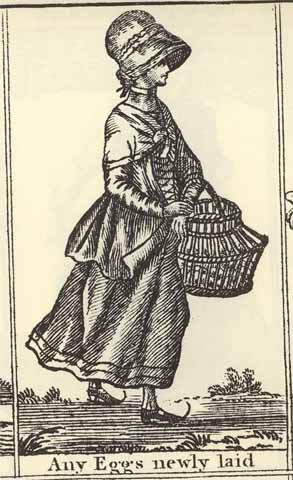
The typical RevWar era brim is downward pointing. However, not all are. Brim shape varies from a circle with smaller circle (“bite”) taken out of it to a long strip with only slight curve (like the Kannik pattern). The circle-with-circular-bite shapes give a typical RevWar shape (similar to a modern baseball cap brim). The strip shapes give a fairly tubular brim, unusual for the RevWar era, although see Walton's The Silver Age for a closish match and Catchpenny #152 (Any Eggs newly laid) for a different style of fairly tubular brim.
Caul shape:
Caul shape appears to vary from an arch to a bowed arch to a circle. If a circle, then the brim meets itself in back. An arch-shaped caul, with a casing through the straight bottom edge and long strings in the casing, yields a bonnet that can be stored flat. A bowed arch or circle yields a smaller, neater caul. Some bonnets have smooth stiff cauls. Are these the oft-mentioned “jockey bonnets”? I don't know, and I don't know how those cauls are constructed. Are some cauls made of a strip sewn into a loop and then tightly gathered along one edge like the pleated circle at the back of a cloak hood? I'm not sure, although the bonnet in Catchpenny #152 (Any Eggs newly laid) kind of looks that way.

Color
Based on writings, black was by far the most common color, white a very distant second, then very few blue, even fewer green and brown, and lastly various rare examples. Nancy Watt's study of the Pennsylvania Gazette found about five times as many black bonnets as white bonnets, and hardly any bonnets of other colors.
Materials
Based on writings, taffeta was the most common, with some examples of peelong (satin), velvet, certain wool fabrics such as stuff and camlet, and even a tiny number in linen. Brims could be stiffened with pasteboard, whalebone, or (probably) buckram.
Trim
The most common trim appears to be a gathered strip of self fabric with a bow in the front. Other trims include a bow at the back (or both front and back) and fancier trims. Another possibility is no trim. Most artworks are black and white so it's hard to tell if the trim is self fabric, matching ribbon, or contrasting trim. Silk taffeta will hold an edge well if pinked so makes a good material for self fabric trim. Some runaway ads mention bonnets with lace (not many). The bonnet in Sandby's Mrs. Lane appears to be trimmed with narrow lace or cord and with ruched or gathered or textured ribbon. Trim along the front edge is not common but is occasionally seen.
Strings
Strings (ties) are not generally visible in art. Bonnets generally stay on well without being tied, and you can tuck ties up in the brim until needed in very cold or windy weather.
Safety Note
A bonnet will affect your perception of sound. Depending on how far down over your ears your bonnet comes, it may merely dampen echoes, or may change your perception of where sounds come from, or may even eliminate sounds from some directions almost entirely. Test your bonnet, and if it affects your hearing significantly, then be careful when wearing it, especially when crossing streets!
I find that any bonnet that covers half the ears or less doesn't impair hearing badly, but “your mileage may vary”. My bonnet comes about halfway down my ears. While there is an interesting sound change (compare how certain room shapes, like concert halls, can reflect sound differently from normal), my hearing is not impaired to any noticeable degree. My bonnet brim allows me to see straight ahead and (mostly) to the sides but cuts off all upward vision. This is great for keeping sun out of eyes and still lets me see ground level traffic, but does limit visibility noticeably.
Documentation
Artifacts
- Woman's hat [sic], black silk, 1770– 1780, England. Colonial Williamsburg Foundation, Acc. No. 1993-335. Black ribbed silk, boned brim with baleen stays. The bonnet was on display at the DeWitt Wallace's Language of Clothing exhibit and it is pictured on p. 9 of What Clothes Reveal (Linda Baumgarten, CWF with Yale University Press, 2002).
Art
- The Catchpenny Prints collection has more bonnets than in any other single source I know of, and a good variety, too. See #s 24, 107, 120, 138, 140, 152, 184, 196. Some are good examples; some are European (Dutch) or perhaps really hats or caps. (Bowles and Carver. Old English Cuts and Illustrations for Artists and Craftspeople. Dover Books, ISBN: 0–486–22569–0.)
- A view in St Paul's Churchyard on a windy day, 1740. The Guildhall Art Gallery, p5438014. Very rare early bonnet.
- Edward Penny, The Marquess of Grandby aiding a sick soldier, 1765. Reproduced in: Johnson, E.D.H. Paintings of the British Social Scene: From Hogarth to Sickert. Reissue edition: Weidenfeld & Nicolson Ltd, 2000, ISBN 0297789090. Very conical brim shape.
- The RIVAL MILLENERS. John Collet pinx.t Rob.t Laurie fecit. Publish'd as the Act directs, 2.d March 1772. Printed for Rob.t Sayer, N.o 53 in Fleet Street, London. Colonial Williamsburg Foundation, Acc. No. 1955-125. The flattened shape across the front of the brim, bordered by two vertical lines, may indicate that this bonnet is stiffened with whalebone.
- Grimm pinx. Dickenson fecit. Fording the Brook. Published according to the Act 1 Decr 1772. Printed for John Bowles, at No. 13 in Cornhill. New York Public Library, Satyr p.194.
- An old macaroni miss-led. [London] : Pub. accor. to act, by MDarly, Strand, April 26th 1772. Lewis Walpole Library, Yale University, 772.04.26.02. Unusually small and flat brim, almost like a modern baseball cap, with a comparatively large and puffy caul. There is ruched or gathered trim along the front edge of the bonnet (compare Sandby's Mrs. Lane.
- A ladies maid purchasing a leek. Brandoin pinxt. ; Caldwall sculp. [London?: s.n. 1772]. Lewis Walpole Library, Yale University, 772.03.01.01.2. Smallish brim with largish caul. The most notable feature is the odd trim.
- The pretty mantua maker. Pub according to Act Jany. 1 1772 by MDarly Strand. Lewis Walpole Library, Yale University, 772.1.1.3.1. Compare An old macaroni miss-led.
- The Abusive Fruitwoman. Pubd 25th Feby 1773 by J.R. Smith. Library of Congress, PC 3 - 1773 - Abusive fruitwoman c-P&P(A size).
- Heyday! Is this my Daughter Anne! F.E. Adams invt. et fecit. Publish'd Decr. 6 1773 by John Bowles No. 13 in Cornhill. What is a country woman doing in an ermine(???)-edged short cloak?!
- An evenings invitation, with a wink from the bagnio. [London]: Printed for Carington Bowles, Map & Printseller, No. 69 in St. Paul's Church Yard, London, published as the act directs, [ca. January, 1773]. Lewis Walpole Library, Yale University, 773.01.00.02+. White bonnet with pink trim. Smallish brim, tallish caul.
- The invitation. London : Printed for Robt. Sayer & J. Bennet, No. 53 Fleet Street, as the act directs, 22d July 1774. Lewis Walpole Library, Yale University, 774.07.22.01+. White bonnet with brim stiffened with whalebone.
- A call to the unconverted Cole fecit. London : Publish'd April 15, 1774, by W. Humphry, St. Martin's Lane, [1774]. Lewis Walpole Library, Yale University, 774.04.15.01+. Two women wear bonnets. Three other women appear in the print; one wears a hat, one a cap, and one is unclear but may wear a handkerchief over a cap.
- Cole fecit. London : Publish'd April 15, 1774, by W. Humphry, St. Martin's Lane, [1774]. Lewis Walpole Library, Yale University, 774.04.15.01+. Two women wear bonnets. Three other women appear in the print; one wears a hat, one a cap, and on is unclear but may wear a handkerchief over a cap.
- Dawe, Philip (attributed to). A SOCIETY of PATRIOTIC LADIES, at EDENTON in NORTH CAROLINA. London, Printed for R. Sayer & J. Bennett, N.o 53 Fleet Street, as the Act directs 25 March 1775. Colonial Williamsburg Foundation, 1960-132. Contains two bonnets (also six hats, one small, fancy cap, and one head wrap). Appears to be a satirical print (despite the naive commentary on the CW page). The bonnet in back somewhat resembles the bonnet in The invitation in the shape of the caul. The bonnet in front has deep indentations in the caul running from front to back; is this the style called "mushmelon"? The bonnets may be exaggerated in form, but it is likely that bonnets of the general shape existed, perhaps with lower or less-indented cauls.
- Henry Walton, The Silver Age, c. 1776–7. More tubular shape than most though still doesn't approach a 19th century poke bonnet.
- The lover's disguise. London : Printed for and sold by Carington Bowles, No.69 in St. Pauls Church Yard, [1776?]. Lewis Walpole Library, Yale University, 778.01.01.05. Narrow brim, bands of trim going crosswise over caul.
- The old maids morning visit, or, The calash lady's. [London] : Pubd. M Darly 39 Strand, Marh 11, 1777. Lewis Walpole Library, Yale University, 777.03.11.01+. Bonnet on floor at left; a mother cat and kittens appear to have made it their home.
- The young mendicant Josiah Boydell, pinxit.; V. Green, ... fecit. [London] : Published March 1st 1776, by J. Boydell, engraver in Cheapside, London, [1776]. Lewis Walpole Library, Yale University, 776.03.01.04. The brim is creased in several places.
- The slip, or, Miss, willing to be in the ton. London : Printed for Ino. Smith, No.35, Cheapside as the Act directs, 11th Septr. 1777. Lewis Walpole Library, Yale University, 777.09.11.01+. Narrow, fairly vertical brim.
- Miss Tipapin Going For All Nine. From the Original Picture by John Collett in the possession of Carington Bowles. Printed for & Sold by Carington Bowles, at his Map & Print Warehouse, No. 69 in St. Pauls Church Yard, London. Publish'd as the Act directs [after January 1, 1778?]. Lewis Walpole Library, Yale University, 778.01.01.05. I think the black one's a bonnet. Probably the rest are hats.
- Smith, John Raphael, 1752–1812, printmaker. A lady in waiting. [London] : Printed for & sold by Carington Bowles, at his Map & Print Warehouse, No. 69 in St. Pauls Church Yard, London. Publish'd as the Act directs, [ca. 2 September 1780]. Lewis Walpole Library, Yale University, 780.09.02.01+. This huge bonnet suits the large hairstyles of the 1780s.
- An ENGLISH MAN of WAR, taking a FRENCH PRIVATEER. Printed for & Sold by CARINGTON BOWLES, at his Map & Print Warehouse, N.o 69 in S.t Pauls Church Yard, London. Published as the Act directs, 4 June, 1781. Colonial Williamsburg, Acc. No. 1962-290. Probably a bonnet rather than a hat, but it is impossible to be sure due to the quantity of trim on the caul/crown. Also at the Lewis Walpole Library Digital Collection, 781.06.00.01+ with different coloration and a different interpretation of the swag at her proper right of her bonnet or hat.
- Allan, David. Edinburgh Lacewoman. 1784. On the Web at Before the Clearances: 17th and 18th Century Scottish Costume (scroll down or search for the artwork name to find it). The woman is a Scottish Lowlander.
- Cruikshank Isaac. An Ordinary on Sundays at Two O'Clock, 1793. Note late date.
- Paul Sandby, Mrs. Lane. Date not available. Image not available on the Web. Appears in Sandby Drawings at Windsor Castle, by A.P. Oppé; Phaidon Press, Ltd, London, 1947. Also appears as the frontispiece in Patricia Baines' Spinning Wheels, Spinners and Spinning (republished by Robin & Russ). Typical shape but on the small side and with trim along the front of the brim as well as the back.
- Reynolds, Joshua. Miss Palmer. Date not available. Faintly visible lines radiating across the brim indicate that this bonnet's brim is boned like the Colonial Williamsburg artifact.
For additional, later bonnets, see 18th Century Notebook : 18th Century Women's Bonnets.
For a Germanic (?) style of bonnet, see:
- Pesne, Antoine. Elisabeth Oberbüchler, 1732. A protestant refugee from Salzburg. On the Web at La Couturière Parisienne.
- Chodowiecki, Daniel Nikolaus. A Fair in Berlin. Reproduced in Aileen Ribeiro's Dress in Eighteenth Century Europe, 2002, and on the cover of the Burnley & Trowbridge catalog (detail).
- The Purim Festival in the Portugese Synagogue, Amsterdam reproduced in The Jewish Calendar 2001: With Illustrations from the Collection of the Jewish Museum, New York, March. Basset (French 1700s). After L.F. du Bourg (Dutch, 1693–1775), 18th century. Engraving, JM 20–67. Photo: John Parnell.
Writings
Newspapers contain many written references, some mentioning color, fabric, lining color, lining fabric, size, condition, or style. Most mentions are in ads for runaways, and some are for stolen goods or goods for sale. Unless otherwise noted, these bonnets are from The Pennsylvania Gazette:
- 1732, “a new plat bonnet lined with red silk which she stole in New-Castle fair” (American Weekly Mercury)
- 1740, “a Platt Bonnet lined with light red Silk”
- 1741, “an old black silk Bonnet, pretty much torn”
- 1751, “a laced Bonnet”, “Just imported from London, in the Myrtilla, … silk bonnets”
- 1759, “just imported from London … shade bonnets plain and fettled”
- 1760, “a new black Silk persian Bonnet”, “black Sattin Bonnet”
- 1761, “Check Linen Bonnet”, “a black Sattin Bonnet, lined with white”, “a new black Silk Bonnet”, “from London … black Sattin Hats & Bonnetts” (Boston News-Letter)
- 1763, “a black Peeling Bonnet, with Pasteboard and Gimp round it”, “a black Silk Bonnet”, “a black Silk Fly Bonnet”, “light blue Bonnet”, “an old black Bonnet”
- 1764, “one black Peeling Bonnet, lined with Taffety”, “black bonnet”, “Bonnets proper for Widows and other Ladies, are made in the genteelest Manner, and sold by Anne and Elizabeth Cummings” (Boston Gazette), “with no other Token of Mourning than a black Bonnet, Gloves, Ribbons and Handkerchief” (Boston Gazette)
- 1766, “a striped linen bonnet”, “a Bath Bonnett, covered with black Taffety, lined with dyed Linen”
- 1767, “a Bonnet”, “a white Bonnet”, “took her Mistress's Bonnet”, “one black bonnet, with green lining”
- 1768, “a black sattin bonnet, with whalebone all round”, “an old black bonnet”
- 1769, “a new black taffety bonnet, lined with blue persian”
- 1770, “one black peelong bonnet, trimmed with the same”
- 1771, “an old green whalebone bonnet”
- 1772, “an old changeable silk bonnet, lined with blue silk, and tied with a white ribbon”, “a linen check bonnet”, “black sattin laced bonnet”, “a black silk bonnet”, “Now selling … Dunstable and chip hats and bonnets”
- 1773, “a blue silk bonnet”
- 1774, “a black bonnet” (Boston Evening Post), “an old black silk bonnet”, “a black Silk Bonnet” (Virginia Gazette)
- 1775, “A new black pelong bonnet, with black lace around it”, “a new black taffety bonnet”, “a pale blue silk bonnet”, “2 bonnets, one black, the other white”, “a black bonnet”, “an Irish servant maid … she has no bonnet on, as she has commonly a ribbon round her head”
- 1776, “reddish coloured worsted bonnet”, “one white halfworn peeling bonnet”, “a black alamode bonnet with lace”, “a cloth coloured pelong bonnet, lined with pale blue mantua”, “two Irish servant women … each a black bonnet”
- 1777, “black bonnet with blue lining”, “black silk bonnet with ribbon round the crown”, “a black silk bonnet with white silk lining” (The Penna. Evening Post), “and without a bonnet or hat”
- 1778, “one black mode bonnet lined with white”, “old fashioned black silk bonnet”, “green flowered satin bonnet … about half worn”
- 1779, “one black silk bonnet with a drawed crown”
- 1785, “a black, silk bonnet, with white lining”, “an oil cloth hat or bonnet”
- 1786, “a black silk bonnet almost new”
- 1790, “an old black bonnet”
Inventories are another good source of documentation, for example:
- 1761, Mary Nutter, Portsmouth, £3713, “… a Bonnet and a … Velvet hood”
- 1762, Margaret Chambers, Portsmouth, £10972, “…Velvet Bonnet and handkerchief”
- 1768, Elizabeth Amsden, Deerfield, “… 1 cambelt Riding hood, 1 black Capuchine Cloak, 2 Red Broadcloth Do, 1 Velvet bunnet … 1 Velvet hood”
Footnotes
* From The general index as to twenty-seven volumes of the London Magazine, or the Gentleman's Monthly Intelligencer, Vol. XL, for the year 1771, page 308.