


If a location sensor also has memory, it will be able to detect
changes to the number of targets in the FOV during a short time
interval. We call such a change a field-of-view event (FOV event
for short), which is a second type of critical events of our
interest. Furthermore, if the sensors know where a FOV event happens,
these events can be associated with corresponding shadows. For a
shadow  , three FOV events are possible: 1) A target enters
from the FOV, 2) A target exits
into the FOV, and 3)
Nothing happens at the boundaries between
and the FOV (for a period of time), or null event. Denoting these events
, three FOV events are possible: 1) A target enters
from the FOV, 2) A target exits
into the FOV, and 3)
Nothing happens at the boundaries between
and the FOV (for a period of time), or null event. Denoting these events
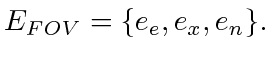
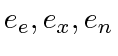 , respectively, the collection of possible
field-of-view events for a shadow
is the set
, respectively, the collection of possible
field-of-view events for a shadow
is the set
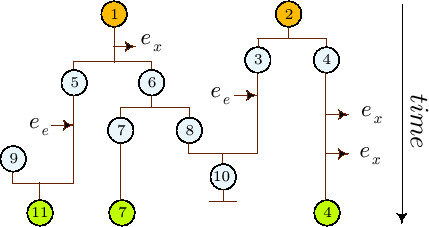
Some sensors may only detect the enter and exit events explicitly, such as a sensing node in a sensor network that only senses targets passing through the boundary of its sensing range. For detection beams, the FOV is a line segment, which causes two FOV events to happen consecutively (see Figure 6).
 |
 |
 in the free space
  , it makes sense to treat them
as a whole. It does not take much to represent them together: We can
simply augment the shadow sequence to include the FOV events. A
typical combined sequence of critical events is shown in
Fig. 7. With the introduction of FOV
events, the invariance from Observation 1
needs to be updated.
, it makes sense to treat them
as a whole. It does not take much to represent them together: We can
simply augment the shadow sequence to include the FOV events. A
typical combined sequence of critical events is shown in
Fig. 7. With the introduction of FOV
events, the invariance from Observation 1
needs to be updated.
To see why the above statement is true, note that an enter FOV event can be viewed as an appear component event immediately followed by a merge component event. Same breakdown holds for exit FOV events. The case is then reduced to Observation 1. Observation 2 establishes that for the task of tracking hidden targets that move nondeterministically, nearly all information (sensor data) can be discarded.