dramatically. For example, for our specific task of tracking
hidden targets in shadows, all we need to know is the initial
distribution of targets, the component events, and the FOV
events. Since targets move unpredictably, other information
contained in
dramatically. For example, for our specific task of tracking
hidden targets in shadows, all we need to know is the initial
distribution of targets, the component events, and the FOV
events. Since targets move unpredictably, other information
contained in  does not help: the robots' exact location, the
shape of the workspace shadows, and what the targets in the FOV are
doing are not relevant. Thus, Observation 2 allows us to construct a derived I-space
does not help: the robots' exact location, the
shape of the workspace shadows, and what the targets in the FOV are
doing are not relevant. Thus, Observation 2 allows us to construct a derived I-space
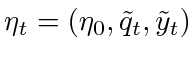
 , called the shadow sequence I-space that discards the irrelevant information. Consider the information
contained in
, called the shadow sequence I-space that discards the irrelevant information. Consider the information
contained in
 . In
,
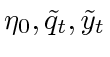
the following reductions are made to
. In
,
the following reductions are made to
 :
:
 .
.
 and
and
 . Sometimes
is not needed, such as a
point robot equipped with omni-directional, infinite range sensor
moving in a known 2D or 3D environment. For such setups, component
events happen when the point robot's trajectory crosses critical
lower dimensional surfaces in the workspace. In the other extreme,
the particular configurations do not even need to be measured,
provided that there is some alternative way to determine the shadow
components (for example, they can be inferred from depth
discontinuities in a planar, simply connected free space
[40]).
is compressed so that only
changes and time between changes need to be recorded. Every such
change corresponds to the observation of a FOV event. The process
yields a sequence of distinct observations.
. Sometimes
is not needed, such as a
point robot equipped with omni-directional, infinite range sensor
moving in a known 2D or 3D environment. For such setups, component
events happen when the point robot's trajectory crosses critical
lower dimensional surfaces in the workspace. In the other extreme,
the particular configurations do not even need to be measured,
provided that there is some alternative way to determine the shadow
components (for example, they can be inferred from depth
discontinuities in a planar, simply connected free space
[40]).
is compressed so that only
changes and time between changes need to be recorded. Every such
change corresponds to the observation of a FOV event. The process
yields a sequence of distinct observations.
 (Fig. 7 gives an example) that lives in
. Although we cannot say that
is the smallest
I-space that is sufficient for solving the task of tracking targets in
shadows, it immediately reveals much more structure that is intrinsic
to the task than
does. From this we observe a general pattern
that we exploit: Given
and a task, we try to find one or more
sufficient derived I-spaces, and work exclusively in these derived
I-spaces. As we will see shortly, further reduction of information may
again be possible depending on the tasks, yielding more compact
I-states and I-spaces.
(Fig. 7 gives an example) that lives in
. Although we cannot say that
is the smallest
I-space that is sufficient for solving the task of tracking targets in
shadows, it immediately reveals much more structure that is intrinsic
to the task than
does. From this we observe a general pattern
that we exploit: Given
and a task, we try to find one or more
sufficient derived I-spaces, and work exclusively in these derived
I-spaces. As we will see shortly, further reduction of information may
again be possible depending on the tasks, yielding more compact
I-states and I-spaces.
In practice, this suggests that if the task is known
before the observation history is obtained, the derived I-state can be
obtained ``online''. Most of
can be discarded once we have
, and
 can then be obtained from
and
can then be obtained from
and
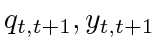 , which are the information accumulated during
the time interval
, which are the information accumulated during
the time interval ![$ (t, t+1]$](img144.gif) . This is illustrated for
and
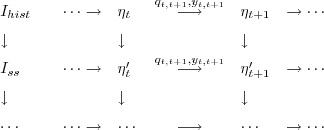
in Fig. 8. Computationally, the shadow
sequence can be obtained by storing and processing only immediate
history. At a given time
. This is illustrated for
and
in Fig. 8. Computationally, the shadow
sequence can be obtained by storing and processing only immediate
history. At a given time  , since our analysis establishes a 1-1
correspondence between workspace-time shadows and workspace shadows
at
, we only need to look at observation history between
, since our analysis establishes a 1-1
correspondence between workspace-time shadows and workspace shadows
at
, we only need to look at observation history between
 (
(
 is a small real number) and
to detect component events. That is, workspace-time shadows,
which determines the shadow sequence, can be recovered from
workspace shadows. Similar techniques apply to the detection of FOV
events.
is a small real number) and
to detect component events. That is, workspace-time shadows,
which determines the shadow sequence, can be recovered from
workspace shadows. Similar techniques apply to the detection of FOV
events.
 , it is also possible to derive it from