


In this setting, we assume that the targets move
nondeterministically. In particular, when a shadow  splits into
shadows
splits into
shadows  , the targets inside
can split in any possible
way as long as the numbers of targets in
are both
nonnegative. The component events and FOV events are assumed to be
observed without error. Given such assumptions, the observation
history can be partitioned into two inputs to our filter
algorithm:
, the targets inside
can split in any possible
way as long as the numbers of targets in
are both
nonnegative. The component events and FOV events are assumed to be
observed without error. Given such assumptions, the observation
history can be partitioned into two inputs to our filter
algorithm:
 .
.
 denotes a subset of target attributes (such as having
red color). We assume that elements of the set
denotes a subset of target attributes (such as having
red color). We assume that elements of the set  for a shadow
are pairwise disjoint: If
has red color, then no
for a shadow
are pairwise disjoint: If
has red color, then no
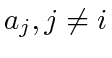 can include targets with the attribute of having red color. The
corresponding
can include targets with the attribute of having red color. The
corresponding  and
and  denote the lower and upper bounds on the
number of targets in the shadow with attribute
. For example, we
may know that at the beginning, a shadow have
denote the lower and upper bounds on the
number of targets in the shadow with attribute
. For example, we
may know that at the beginning, a shadow have  to
to  green targets
and
green targets
and  targets that may be blue or red. In this case, the initial
condition can be written as
targets that may be blue or red. In this case, the initial
condition can be written as

With these inputs, the main task is to determine the lower and upper bounds on the number of targets in any given set of shadows at
 for any combinations of attributes.
To make the explanation of the algorithm clear, we first work with a
single attribute and ignore FOV events. We also assume for the moment
that the initial conditions are tight in the sense that all possible
choices of values must be consistent with the later observations (for
example, we cannot have a initial condition of  to
targets in a
shadow and later find that it is only possible to have
to
targets in a
shadow and later find that it is only possible to have  targets in
it). We will then show how FOV events, multiple attributes, and other
extensions can be handled incrementally.
targets in
it). We will then show how FOV events, multiple attributes, and other
extensions can be handled incrementally.
