


For the simplest case, since there is a single attribute and the FOV
events are ignored, we can represent the number of targets in a shadow
with a single unknown quantity. Let the set of shadows be  ;
we denote the set of corresponding unknowns as
;
we denote the set of corresponding unknowns as  . We can write
the initial condition for each shadow at
. We can write
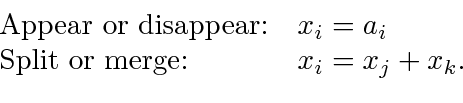
the initial condition for each shadow at  as two constraints
 targets may hide
in
targets may hide
in  at the same time. This is more general than letting
  . To unify notation, we write these in the same way as the initial
conditions by letting
. To unify notation, we write these in the same way as the initial
conditions by letting
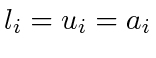 . The same applies to the
disappear events. Additionally, we have for each shadow
, the
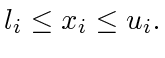
constraint
. The same applies to the
disappear events. Additionally, we have for each shadow
, the
constraint
 indexed by
 . For the upper bound, we can write the
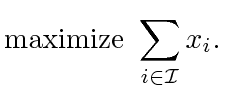
problem as maximizing the sum of the set of unknowns
because the total number of
targets are preserved. We have obtained a standard integer linear
programming (ILP) problem described by
(2),(3),(4), and (5). We may
group the constraints in (2),(3), and
(4) and express the problem as (each equality constraint
becomes two inequality constraint)
. For the upper bound, we can write the
problem as maximizing the sum of the set of unknowns
because the total number of
targets are preserved. We have obtained a standard integer linear
programming (ILP) problem described by
(2),(3),(4), and (5). We may
group the constraints in (2),(3), and
(4) and express the problem as (each equality constraint
becomes two inequality constraint)
PROOF. We use induction over the size of square submatrices of
 to prove that all such submatrices must have determinant 0
or
to prove that all such submatrices must have determinant 0
or
 . As the base case, every element of
is 0
or
. Suppose that all square submatrices of order
. As the base case, every element of
is 0
or
. Suppose that all square submatrices of order  have determinant
 . Denote these matrices
 . Suppose there is a
square submatrix
. Suppose there is a
square submatrix  of
of order
of
of order  with determinant not in
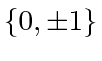 . Every constraint arising from (2),
(3), and (4) except
. Every constraint arising from (2),
(3), and (4) except
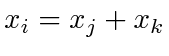 introduces
rows in
with a single
in them; the rest of the row
contains only 0
s. If
contains a row arising from these types of
constraint then
must have determinant
by
induction. Suppose not. In this case, all rows of
are introduced
by constraint of type
. Each such constraint brings
in two rows of
with opposite signs and therefore cannot both
appear in
. We can assume that
's first row have coefficients
coming from one of the rows introduced by a split event,
. As a first case, let the
introduces
rows in
with a single
in them; the rest of the row
contains only 0
s. If
contains a row arising from these types of
constraint then
must have determinant
by
induction. Suppose not. In this case, all rows of
are introduced
by constraint of type
. Each such constraint brings
in two rows of
with opposite signs and therefore cannot both
appear in
. We can assume that
's first row have coefficients
coming from one of the rows introduced by a split event,
. As a first case, let the  th columns of
correspond
to
th columns of
correspond
to
 th columns of
, respectively. To make
's
determinant not in
, there needs to be another row in
that contains exactly two non zero elements among
th
columns. This is only possible if
th columns of
, respectively. To make
's
determinant not in
, there needs to be another row in
that contains exactly two non zero elements among
th
columns. This is only possible if  and
and  merge again, giving
a constraint of the form
merge again, giving
a constraint of the form
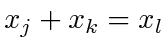 . We may let this row be the
second row in
. This suggests that
. We may let this row be the
second row in
. This suggests that  th column of
are all
zeros after the second row; but this gives us that
has determinant
0
. The second case is that
includes only two columns of
's
th columns. It can be checked similarly that
must have
determinant 0
.
th column of
are all
zeros after the second row; but this gives us that
has determinant
0
. The second case is that
includes only two columns of
's
th columns. It can be checked similarly that
must have
determinant 0
.
PROOF OF PROPOSITION 3. When
the constraint matrix
is totally unimodular and  is a vector of
integers, then the minimal faces of the constraint polytope must
assume integer coordinates, making the solution of the relaxed linear
programming (LP) problem also the solution to the original ILP problem
[32]. It is clear that
in (6) is integer. Lemma
4 gives us that
is totally unimodular. Therefore, a
polynomial time algorithm such as interior point method can be applied
to solve (6).
is a vector of
integers, then the minimal faces of the constraint polytope must
assume integer coordinates, making the solution of the relaxed linear
programming (LP) problem also the solution to the original ILP problem
[32]. It is clear that
in (6) is integer. Lemma
4 gives us that
is totally unimodular. Therefore, a
polynomial time algorithm such as interior point method can be applied
to solve (6).


![[*]](file:///C|/latex2html-install/icons/footnote.gif)