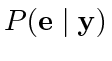
 is known). As events happen, the probability mass
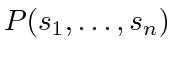 , is updated according to a straightforward algorithm
(Table III and IV) based on
the analysis in section VI-D, in which the observation data structure is defined in Table II.
, is updated according to a straightforward algorithm
(Table III and IV) based on
the analysis in section VI-D, in which the observation data structure is defined in Table II.

|
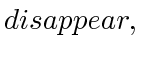
event type, can be one of appear, disappear, split, merge component events and enter, exit, null field-of-view events |

|
the originating shadow in a split event |

|
the first new shadow after a split event |

|
the second new shadow in a split event |

|
the first shadow in a merge event |

|
the second shadow in a merge event |

|
the newly merged shadow |

|
the newly appeared shadow from an appear event |

|
the number of targets in an appear event |

|
the disappearing shadow in a disappear event |

|
the number of targets revealed in a disappear event |
| initial target distribution
|
queue  of observation sequence
 |
| split rule |
| sensor statistics
|
| the target distribution after all observations |
foreach event observation  in
in
|
|---|
switch( )
) |
| case appear: |
update all
 entries to
 |

|
| case disappear: |
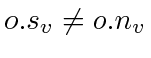
remove all joint distribution entries with
|
| renormalize the probability masses |
| case split: |
add two new shadows  ,
, 
|
split prob. mass in  into
,
by split rule
into
,
by split rule |
| case merge: |
add a new shadow 
|
collapse probability mass from
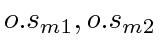 into
into
|
| case enter, exit, null: |
| call PROCESS_FOV_EVENT |
| return the updated target distribution |
| target distribution
|
| sensor statistics
|
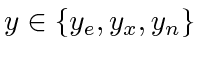
field-of-view observation
|
the affected shadow 
|
| the target distribution after the observation |
foreach
 entry in the distribution
 |
|---|
let

|
let

|
if 
|
let

|
| else |
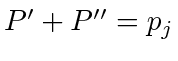
normalize  such that
|
remove
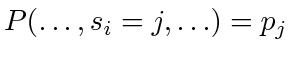 entry
entry |
store entries
and  if applicable
 |
| return the updated target distribution |
 |
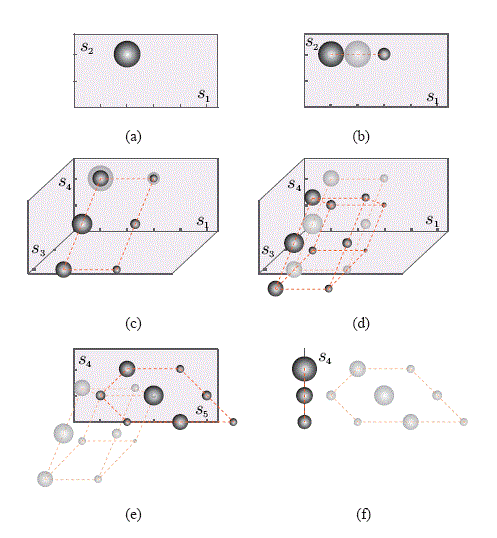 |
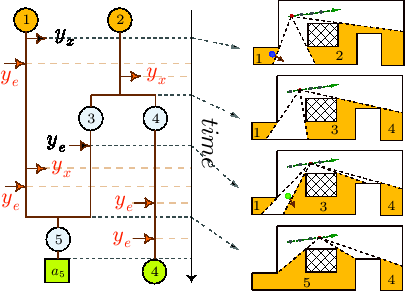
As a demonstration, we work through the observation sequence given by
Fig. 12, with the following assumptions:
1) Initially there are 2 targets each in shadow  , 2) the
split rule is that each target has
, 2) the
split rule is that each target has  probability of going into
each of the two split shadows, 3) there is no null event or
observation, with the true positive rate for any observation being
probability of going into
each of the two split shadows, 3) there is no null event or
observation, with the true positive rate for any observation being  , and 4)
  with probability
and
with probability
and  with
probability
. The extra assumptions are made so that the
calculation of the probability mass entries are limited (so that they
can be listed in a table). The observation by observation processing
is shown in Table V. The distribution is represented
using a table of joint probabilities, which is always practical when
there are not too many targets and events. Renormalization is
performed in the third step for the first and sixth entries, as well
as in the last step. In the merge step, the third and seventh entries
from previous step are combined, as are the fifth and ninth entries. A
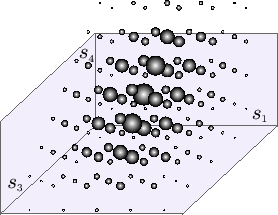
graphical illustration of the probability masses during each step of
the run is given in Fig. 13. Note that the dimensions
change as component events happen.
with
probability
. The extra assumptions are made so that the
calculation of the probability mass entries are limited (so that they
can be listed in a table). The observation by observation processing
is shown in Table V. The distribution is represented
using a table of joint probabilities, which is always practical when
there are not too many targets and events. Renormalization is
performed in the third step for the first and sixth entries, as well
as in the last step. In the merge step, the third and seventh entries
from previous step are combined, as are the fifth and ninth entries. A
graphical illustration of the probability masses during each step of
the run is given in Fig. 13. Note that the dimensions
change as component events happen.
 |
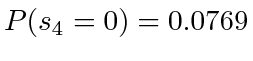
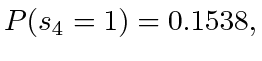
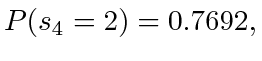
To verify the correctness of the outcome, Monte Carlo trials are also
run, in which individual targets are propagated through the
observation one by one. Since it is not an exact method, we leave the
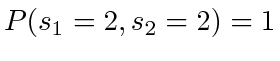
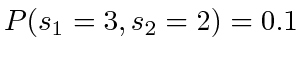
details of it to the next section. After  successful random trials (this is the number of trials used for all Monte Carlo
simulations in this paper), we obtained
successful random trials (this is the number of trials used for all Monte Carlo
simulations in this paper), we obtained
 , which matches closely the results of the
exact algorithm.
, which matches closely the results of the
exact algorithm.
 , is not shown
on the right; we note that additional resource is needed to make
, is not shown
on the right; we note that additional resource is needed to make

 ,
, 









 ,
,