


Now consider the case of probabilistic uncertainty. We use  to denote the shadow with label
  , as well as the random variable for that shadow in the joint/multivariate distribution. For shadows
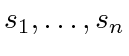 , the joint distribution is then
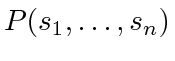 , in which a specific entry is
![$ P(s_1 = x_1, \ldots, s_n = x_n) \in [0, 1]$](img245.gif) . In writing formulas and outlining algorithms, we usually shorten the repeated variables to ``
. In writing formulas and outlining algorithms, we usually shorten the repeated variables to `` '' on both the left hand side (LHS) and the right hand side (RHS) of an expression. In such cases, the combined ``
'' on the LHS and RHS denote the same set of random variables. For example,
'' on both the left hand side (LHS) and the right hand side (RHS) of an expression. In such cases, the combined ``
'' on the LHS and RHS denote the same set of random variables. For example,
 is shortened to
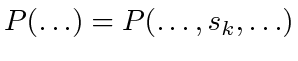 .
.