


Next: Tracking targets as a
Up: Nondeterministically Moving Targets and
Previous: Relation to integer linear
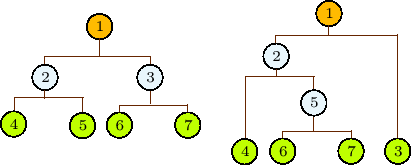
Although a general efficient algorithm is good to have, it may not explore the full structure of a particular problem. One interesting property of our problem is that the distribution of targets in the shadows mimics network commodity flow. Another intrinsic and key property of our problem is that, in many cases, the relative order of component events does not affect the possible target distribution in the shadows. For example, the two sequences of component events from Fig. 9 are equivalent: the set of shadows at  are basically the same.
Figure 9:
Two sequences of component events that are equivalent for task of estimating lower and upper bounds on the number of targets in the shadows at time
.
 |
This allows us to safely discard the intermediate shadows to obtain a
more compact information space
 , the bipartite information
space. The basic idea behind compressing
, the bipartite information
space. The basic idea behind compressing
 into
is
that, since the robots' sensors cannot obtain information from the
shadows as the robots move around, the information that really matters
is how shadows from the beginning and the current time are related,
while discarding the shadows from intermediate times. By conservation
of targets in the environment, the number of targets in the shadows at
into
is
that, since the robots' sensors cannot obtain information from the
shadows as the robots move around, the information that really matters
is how shadows from the beginning and the current time are related,
while discarding the shadows from intermediate times. By conservation
of targets in the environment, the number of targets in the shadows at
 and appeared shadows must be equal that in the shadows at
and disappeared shadows. This hints towards a bipartite graph
structure, which is why we denote the space of such I-states the
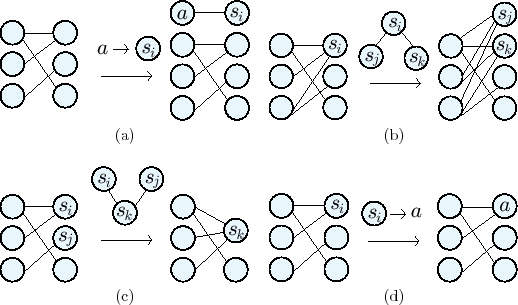
bipartite information space. To do the filtering, the component events
are processed individually according to the procedure shown in
Fig. 10. By the construction of
and
,
we have shown that
and appeared shadows must be equal that in the shadows at
and disappeared shadows. This hints towards a bipartite graph
structure, which is why we denote the space of such I-states the
bipartite information space. To do the filtering, the component events
are processed individually according to the procedure shown in
Fig. 10. By the construction of
and
,
we have shown that
 ,
, and
describe the same ILP problem:
,
, and
describe the same ILP problem:
Proposition 5
Given that targets move nondeterministically, information from
and the corresponding
,
describe the same ILP problem of the form (6).
PROOF. The invariance from Observation 2
gives us that
and
are equivalent in capturing the distribution of hidden targets. To see that
and
are equivalent, we may consider each hidden target individually: Any flow of a target along a shadow sequence is possible in the corresponding bipartite structure, by construction.
Figure 10:
Incrementally computing I-states in
: a) An appear component event in which  targets goes into shadow
  adds two vertices and an edge, with
associated with the left vertex. b) A split event splits a vertex and all edges pointing to that vertex. c) A merge event collapses two vertices into one and collapses their ingoing edges. d) A disappear event in which
is revealed to have
targets in it only associates
with the vertex on the right side.
adds two vertices and an edge, with
associated with the left vertex. b) A split event splits a vertex and all edges pointing to that vertex. c) A merge event collapses two vertices into one and collapses their ingoing edges. d) A disappear event in which
is revealed to have
targets in it only associates
with the vertex on the right side.
 |
Next: Tracking targets as a
Up: Nondeterministically Moving Targets and
Previous: Relation to integer linear
Jingjin Yu
2011-01-18