


Next: Counting
Up: Solving a variety of
Previous: Solving a variety of
Max-flow computations can
also be used to refine the lower and upper bounds from initial
conditions if they are not tight. To get a refined lower bound for a
shadow at  , say
, say  from Fig. 11(b),
let
from Fig. 11(b),
let
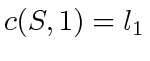 ,
,
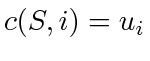 for
for  ,
,
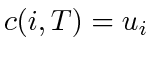 for disappearing shadows, and
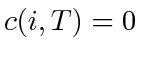 for the rest. After
running max-flow on this network, a tighter lower bound, if there is
one, is given by
for the rest. After
running max-flow on this network, a tighter lower bound, if there is
one, is given by
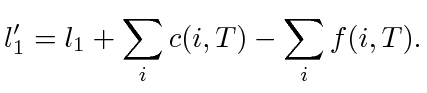 |
(9) |
The summations are over all applicable shadows. To refine  , let
, let
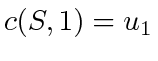 ,
,
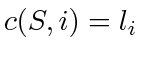 for
,
for
disappearing shadows and
for
,
for
disappearing shadows and
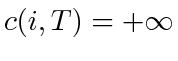 . After running max-flow,
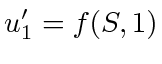 |
(10) |
This procedure also applies to a set of shadows.
Jingjin Yu
2011-01-18