


 , is unknown. For determining
, the lower and upper
bounds on each shadow at
, is unknown. For determining
, the lower and upper
bounds on each shadow at  are set as
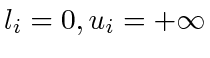 . As new component or FOV events are observed by the robots
moving in the environment, the previous procedure is run to keep
refining the initial bounds. Once we have
. As new component or FOV events are observed by the robots
moving in the environment, the previous procedure is run to keep
refining the initial bounds. Once we have  for each initial
condition,
has been determined. Note that if the free space is not
completely explored, then the upper bound remains at infinity. Another
instance of counting is knowing
. For example, in a wild animal
preserve, it may be required that the total number of a species is
verified periodically. This reduces to the problem of being given
and wanting to account for all of them. To verify the count, we can
keep track of the lower bounds on the total number of targets, and if
the number agrees with
, then the task has been
accomplished.
for each initial
condition,
has been determined. Note that if the free space is not
completely explored, then the upper bound remains at infinity. Another
instance of counting is knowing
. For example, in a wild animal
preserve, it may be required that the total number of a species is
verified periodically. This reduces to the problem of being given
and wanting to account for all of them. To verify the count, we can
keep track of the lower bounds on the total number of targets, and if
the number agrees with
, then the task has been
accomplished.