


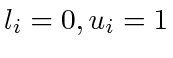
 for each shadow at
  . There are three possibilities for each shadow at
  : 1)
: 1)
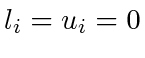 (the evader is not in
  ), 2)
), 2)
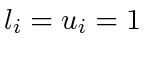 (the
evader is definitely in
), and 3)
(the evader
may or may not be in
). Note that this is a passive version of
the pursuit-evasion problem. We do not determine a trajectory that is
guaranteed to detect the evader. In general, this problem is NP-hard
[12]. Nevertheless, the calculation method
proposed in this paper can be used with heuristic search techniques
(or even human operators) to correctly maintain the status of the
pursuit.
(the
evader is definitely in
), and 3)
(the evader
may or may not be in
). Note that this is a passive version of
the pursuit-evasion problem. We do not determine a trajectory that is
guaranteed to detect the evader. In general, this problem is NP-hard
[12]. Nevertheless, the calculation method
proposed in this paper can be used with heuristic search techniques
(or even human operators) to correctly maintain the status of the
pursuit.