


Next: Processing component events
Up: Probabilistic Events, Observations, and
Previous: Probabilistic Events, Observations, and
Problem formulation
In the basic setup, besides the availability of a sequence of component
and FOV event observations (e.g. Fig. 7), the following assumptions are made:
- Component events are observed without error.
- Targets are indistinguishable. The initial condition is given as
a joint probability distribution
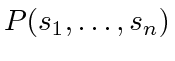 of targets in
the
of targets in
the  shadows at
  .
.
- When a split component event happens, a probabilistic split
rule decides how the targets should redistribute.
- Observations of FOV events follows distribution given by
 .
.
After general algorithms are presented, we discuss extensions relaxing the first two assumptions. The last two assumptions can be satisfied by collecting and analyzing sensor data from the same environment; the necessity of these two assumptions will become self-evident shortly. Given these assumptions, we want to obtain the target distribution in the  shadows,
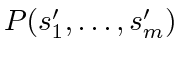 , at time
  .
.
The resulting joint probability distribution is useful in solving many decision making problems; for example, in a fire evacuation
scenario, knowing the the expected number of people trapped in various
parts (shadows) of a building (possibly estimated through observations
from infrared beam sensors or security cameras), firefighters can
better decide which region of the building should be given priority
when they look around. The expected number of people in each shadow
is readily available from the joint probability distribution.
Next: Processing component events
Up: Probabilistic Events, Observations, and
Previous: Probabilistic Events, Observations, and
Jingjin Yu
2011-01-18