


1) Split. A split event introduces more
uncertainty. As a shadow splits into two disjoint shadows, the probability masses in the newly spawned shadows cannot be predicted without additional information because the sensors can not see what happens within the shadow region during a split event. The issue is resolved by the introduction of a split rule, obtained from supporting data or an oracle, which dictates how the originating shadow's probability mass should be redistributed. For example, statistical data may support that the number of targets in the child shadows are proportional to their respective areas.
2) Disappear. When a shadow disappears, the targets hiding behind it are revealed. This information can be used to update our belief about the target distribution by eliminating some improbable distributions of targets. In particular, it can reduce the uncertainty created by split events. For example, suppose that a shadow  , having
  targets in it (with
  probability), splits into shadows
  and
and  . It is possible that
has 0
to
targets in it, as does
. However, if
later disappears to reveal
. It is possible that
has 0
to
targets in it, as does
. However, if
later disappears to reveal  targets in it and no other events happen to
and
, then
must have exactly
targets in it and no other events happen to
and
, then
must have exactly  targets in it. In general, assuming that shadow
disappears with a target distriubtion
targets in it. In general, assuming that shadow
disappears with a target distriubtion  , the update rule is given by

in which the summation is over all joint probability entries of
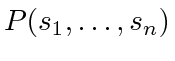 such that
 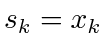 . Normalization is required.
, with distribution
, can be joined with the rest via combining the independent
distributions
with
:
. Normalization is required.
, with distribution
, can be joined with the rest via combining the independent
distributions
with
:
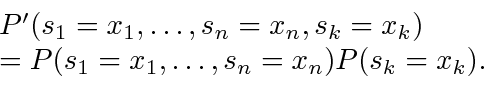
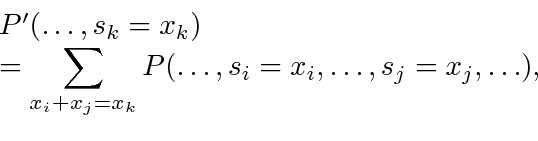
in which
 is the merged shadow of shadows
and
. A detailed example is given in Table I in which the original shadows are
is the merged shadow of shadows
and
. A detailed example is given in Table I in which the original shadows are
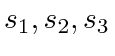 and
and  merge to form shadow
  .
.






