
FreeSnell: Granular Metal Films
- Refractive Index Spectra.
- All-Dielectric Optics
- Metal Films
- Granular Metal Films
- Optical Coherence
- Polyethylene
|
|
http://people.csail.mit.edu/jaffer/FreeSnell/granular.html |
FreeSnell: Granular Metal Films | |
|
FreeSnell is a program to compute optical properties of multilayer thin-film coatings.
This validation suite is from "granular.scm", part of the FreeSnell package. "granular.log" is the text generated by running granular.scm:
scm -l granular.scm > granular.log
In the section on Specifying Materials:
For dielectric films embedded with spherical metal granules much smaller than the thickness of the film and the wavelengths under consideration, Maxwell Garnett Theory provides a means to calculate the effective n and k. The thickness of the granular film must be several times the granule size; otherwise the more complicated machinations of [Granfilm] are required.
- Function: granular-IR n q ns
The n and ns arguments specify the indexes of refraction for the metallic and matrix materials respectively. Each can be either a (complex) number or function of one real argument returning a (complex) number. The real number q is the fractional volume occupied by the metal.
granular-IRreturns a complex index-of-refraction (or function returning a complex index-of-refraction) for the composite layer.If Au is a spectral function, the following three definitions are equivalent:
(define ruby-glass (granular-IR Au 8.0e-6 1.5))
(define (ruby-glass w) (granular-IR (Au w) 8.0e-6 1.5))
(define ruby-glass (lambda (w) (granular-IR (Au w) 8.0e-6 1.5)))
Both n and ns can be functions of wavelength. The formula for the effective index of refraction, ne, paraphrased from Maxwell-Garnett [Garnett] is:
| ne2 | = | ns2 | n2 + 2 ns2 + 2 ( n2 - ns2) q
n2 + 2 ns2 + ( ns2 - n2) q |
|---|
ne(n,q,ns) is a function which returns a blend of complex refractive-indexes n and ns under control of parameter q. When q=0, ne=ns; when q=1, ne=n, both as expected. But ne is not symmetrical; ie. ne(n,q,ns) does not equal ne(ns,1-q,n).
This equation is simpler if we deal with the refractive-index squared: ϵe=ne2, ϵs=ns2, ϵ=n2.
| ϵe | = | ϵs | ϵ + 2 ϵs + 2 ( ϵ - ϵs) q
ϵ + 2 ϵs + ( ϵs - ϵ) q |
|---|
Garnett gives an alternate form:
| ϵe - ϵs
ϵe + 2 ϵs | =q | ϵ - ϵs
ϵ + 2 ϵs |
Solving for ϵe and decomposing:
| ϵe | =ϵs | 1 + 2 s
1 - s | where | s=q | ϵ - ϵs
ϵ + 2 ϵs | =q | 1 - r
1 + 2 r | where | r=ϵs/ϵ |
Let f(x)=(1-x)/(1+2x); then f -1(x)=1/f(x) and ϵe=ϵs f -1(q f (ϵs /ϵ)); a function commutator?
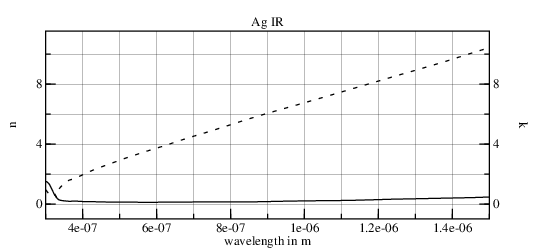
What can going granular accomplish? The graph below plots the real and imaginary parts of the refractive-index of silver, which shows the linear growth of k (and n at a lower slope) with wavelength typical of electrically conductive metals.
|
|---|
|
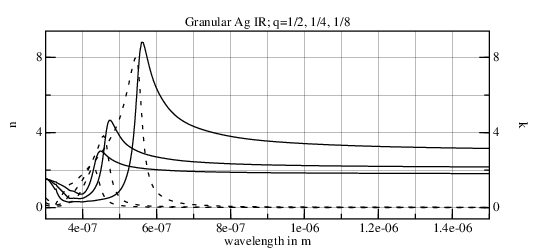
Above are the refractive-indexes of volume-fractions 1/2, 1/4, and 1/8 of granular silver in a matrix having refractive-index=1.5. The granular silver composites give high refractive indexes with low loss at the longer wavelengths where pure silver's k values dominate.
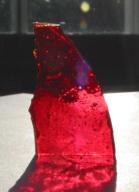
This 3.mm thick shard of gold ruby glass (also called cranberry glass) is shown illuminated from behind by a sunbeam. The red shadow of the shard on white paper occupies the bottom sixth of the image. The whole shard is illuminated by the sunlight, yet the top half of the shard appears nearly as dark as the window frame behind it, indicating that gold-ruby-glass does not appreciably scatter any wavelength of visible light.
| FreeSnell | Table II | ||
|---|---|---|---|
| 0° | gold content | Total gold content | Color by transmitted light |

| 2e-6 | - | Pink |
| 8e-6 | 8e-6 | Clear red | |
| 14e-6 | 14e-6 | Deep red, intense | |
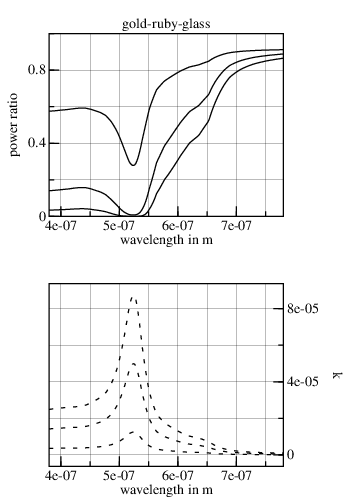
How gold makes gold ruby glass red was one of the motivations for J. C. Maxwell Garnett's 1904 paper Colours in Metal Glasses and in Metallic Films [Garnett]. Table II of that article, taken from Siedentopf and Zsigmondy, `Ann. der Physik', January, 1903, pp. 33, 34, gives the gold content (by volume) and transmission color (and other properties) of eleven 4.mm-thick samples. FreeSnell here simulates gold in a glass with a constant refractive-index of 1.5.
This transmission graph shows valleys centered on 525.nm, which are where the extinction coefficient (shown below) of the gold-glass composites peak.
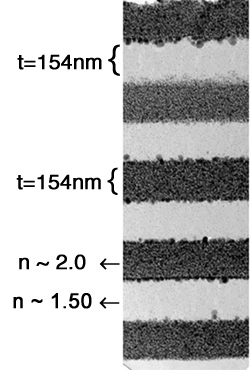
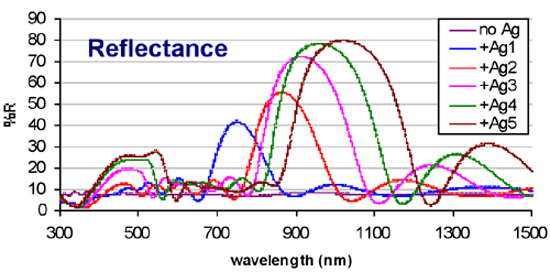
IRG-II: Polymer Multilayer Thin Films That Reflect Light Like Metals from the Center for Materials Science and Engineering of the Massachusetts Institute of Technology offers a chance to check the granular metal formula. With silver particle size below 10.nm, the assumptions of Maxwell Garnett Theory [Heavens] should hold throughout the range of interest. Unfortunately, email inquiry of the center yielded no additional quantitative information about the silver loading of their composite.
Their photomicrograph (right) contains useful information. The light colored regions have n around 1.5, close to that of high-density polyethylene. If this same polymer holds the silver particles, then experimentation with the silver volume fraction quickly finds that a volume fraction of 1/6 yields n of 2.0.
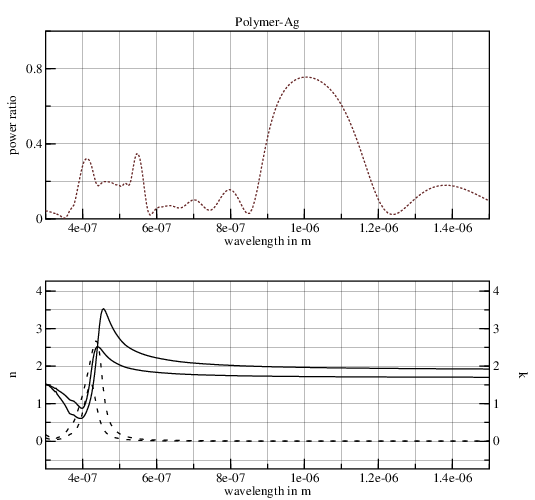
In the photomicrograph, the roughness of boundaries between the silver-loaded HDPE and plain HDPE looks to be larger than 10%. Modeling that roughness with 30.nm thick 1/12 loaded transition zones brings the short wavelength reflectivity down, more in line with the IRG-II graph. The 1/6 and 1/12 indexes of refraction are shown in the bottom chart.
FreeSnell runs of the interleaved stack of 5 silver-loaded and 4 unloaded layers each 154.nm thick on BK7 glass peaks above 1.1.um; but their graph shows it peaking at 1.0.um. Either:
Experimentation finds that a 35 degree angle of incidence moves the peak to 1.0.um, producing the plot shown.
| MIT CMSE | |
|---|---|
 | |
| |
| FreeSnell | |
If this is measured data, then it is a fairly good match. Another tweak might take into account that the second band from the top is lighter than the others in the photomicrograph.
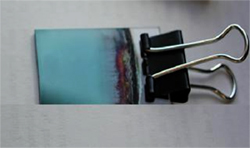
The last piece of evidence from MIT CMSE's site is a photograph of the manufactured material on the right. Below is my computed swatch. The left half is simulation of normal incidence; the right is at 35 degrees. Its being too greenish is the result of the FreeSnell's spectrum having too high a spike at 550.nm.

| |
| 0° | 35° |
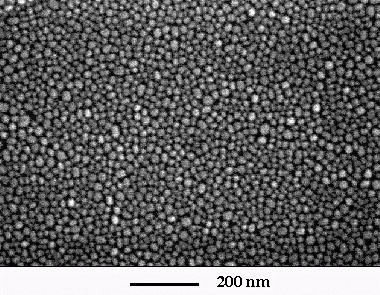
Scanning electron micrography of an Ag deposit on MgO obtained by vapor deposition (equivalent thickness 3nm).
For their case study, the GranFilm authors chose a granular film whose granules are several times larger in diameter than their thickness.
Their 45° incidence and thickness of 3.nm leaves one parameter to determine: the volume ratio of silver to vacuum in the film.
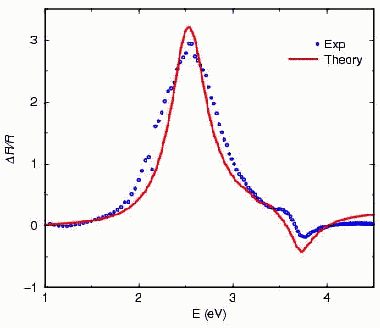
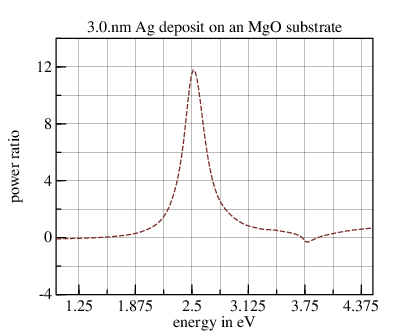
The wavelength where the reflectivity graph peaks is sensitive to the volume ratio, matching the GranFilm plot (shown below) when this ratio is 0.67.
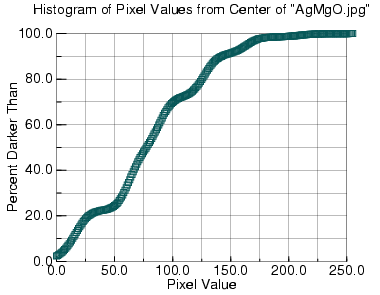 The slope of the histogram of pixel values from the micrography image
is maximal around a pixel value of 60, which higher than 33% of the
pixels. If that darkest third of pixels indicate where the substrate
is visible, then the silver granules cover the remaining 67% of the
surface. Since the thickness of the granule layer is much smaller than
the diameter of the islands, the volume ratio of silver to vacuum, q,
would also be 0.67. So q = 0.67 is not inconsistent with
the micrography.
The slope of the histogram of pixel values from the micrography image
is maximal around a pixel value of 60, which higher than 33% of the
pixels. If that darkest third of pixels indicate where the substrate
is visible, then the silver granules cover the remaining 67% of the
surface. Since the thickness of the granule layer is much smaller than
the diameter of the islands, the volume ratio of silver to vacuum, q,
would also be 0.67. So q = 0.67 is not inconsistent with
the micrography.
 The image to the left shows the center of the micrograph after being
thresholded at pixel value 63 (33% black; 67% white).
The image to the left shows the center of the micrograph after being
thresholded at pixel value 63 (33% black; 67% white).
| GranFilm | |
|---|---|
 | |
| |
| FreeSnell | |
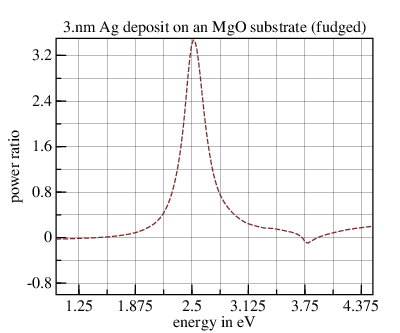
This differential reflectivity (p-polarization) is relative to the reflectivity of plain MgO, which is 0.023 for MgO's index-of-refraction of 1.75 at 0.5.um (2.48.eV).
The curves have remarkably similar shapes, but the vertical scale is off by a factor 4. This calculation has so far been for p-polarization at an incident angle of 45°. If instead of dividing (R_p - .023) by .023 we divide by .078, the MgO reflectance at 0° incidence, the scale conflict nearly vanishes.
| |
|---|---|
| FreeSnell |
Further down on http://www.insp.jussieu.fr/axe2/Oxydes/GranFilm/GranularFilm.html#Case is a large graphic with four plots, all of which have irreconcilable differences with those published in the paper GranFilm: a software for calculating thin-layer dielectric properties and Fresnel coefficients (Thin Solid Films 419, 124 2002). The rest of these plots will be taken from the paper.
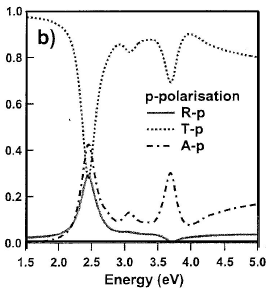
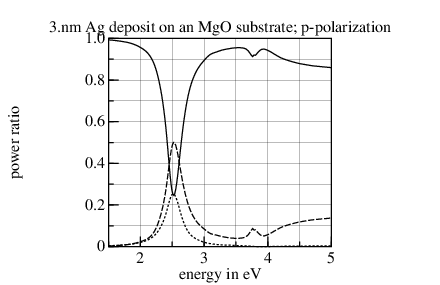
The differential reflectivity depends on the reflectance. Fortunately, the paper contains graphs of the reflectivity, transmittance, and absorption at 45° for each polarization:
| GranFilm | |
|---|---|
 | |
| |
| FreeSnell | |
The reflectance matches reasonably well. Since the reflectances matched, the differential reflectances should have matched also.
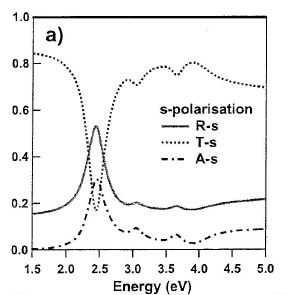
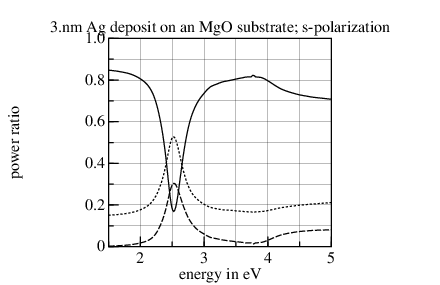
| GranFilm | |
|---|---|
 | |
| |
| FreeSnell | |
The s-polarization reflectance matches reasonably well. Some of the absorption lines which GranFilm calculates are missed by FreeSnell.
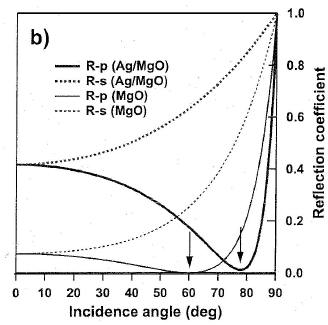
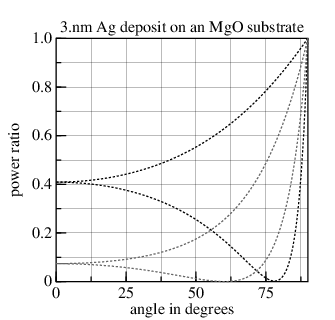
| GranFilm | |
|---|---|
| |
| |
| FreeSnell | |
The reflectance versus angle of incidence match very well for both plain MgO and the granular silver film on MgO at a photon energy of 2.5.eV.
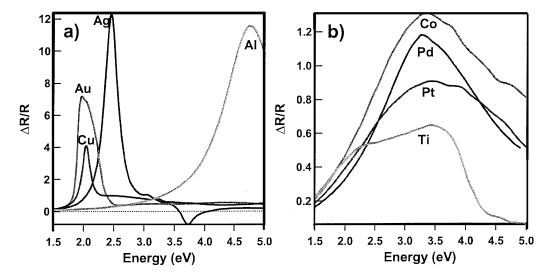
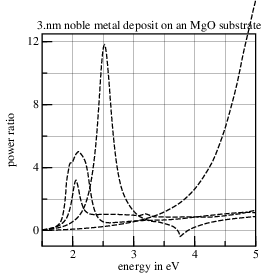
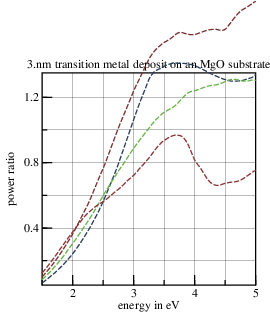
Figure 8 of the paper shows relative reflectivity calculated for 8 metals, each deposited the same way as for silver above (3.nm thick).
| GranFilm |
|---|
|
|
| FreeSnell |
In figure 8, silver reflectance peaks near 12, validating my earlier comments about the scale discrepancy. The other "plasmon-free" metals (gold, copper, and aluminum) peak near where GranFilm calculates, but the amplitudes differ. The reflectivities which FreeSnell calculates for the transition metals cobalt, palladium, platinum, and titanium are very different from GranFilm above 3.eV. According to the paper, plasmons play a significant role in the (granular) optical properties of these metals.
For reflectance of a granular silver film, GranFilm's calcualtions are matched by FreeSnell over wavelength and angle on a case which does not meet the critera for Maxwell Garnett Theory. Either the shape similarity between these curves is a remarkable coincidence; or this case study is a poor demonstration of the power of GranFilm's method vis-a-vis Maxwell Garnett Theory.
In Table 6.2, [Heavens] citing P. Rouard gives a table of the colors of silver and gold sputtered films on glass viewed from the glass side.
| Silver Films | Gold Films | ||||||||||||||||||||||||||
|---|---|---|---|---|---|---|---|---|---|---|---|---|---|---|---|---|---|---|---|---|---|---|---|---|---|---|---|
|
|
Here are the colors of films FreeSnell computes from 1.nm/q to 100.nm/q in thickness with q (volume ratio of metal particles to substrate) from 0.55 to 1.0 under D65 illumination. Color squares with "X" through them are outside of the sRGB gamut.
| Silver Films | Gold Films |
|---|---|
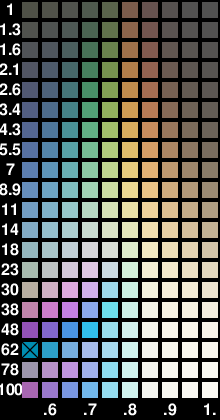 | 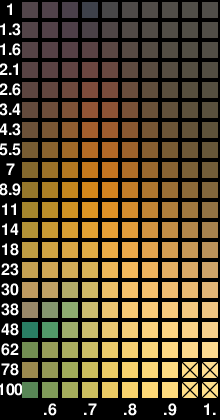 |
It is difficult to find the named colors in the gold chart. Also disturbing is that, while the table claims that colors stop changing above thicknesses of 7.nm and 4.nm respectively, FreeSnell's simulations show those thresholds being much higher. This is especially strange for q=1 (solid metal), where Maxwell-Garnett theory is not involved. The lower right corner of both charts looking like silver and gold is some consolation.
 The 3.nm silver film discussed previously was
"elaborated by vapor deposition in ultra-high vacuum conditions"
versus sputtering for Rouard's table. Both GranFilm and FreeSnell
calculate reflected spectra peaking sharply at 2.5.eV (= 500.nm) for a
granular film (with q = 0.67). Its color at 30° incidence is
shown to the right.
The silver-on-glass response computed by FreeSnell is hardly different
from silver-on-MgO. These films will therefore appear green; and the
corresponding cell on the silver chart is indeed a deep green.
The 3.nm silver film discussed previously was
"elaborated by vapor deposition in ultra-high vacuum conditions"
versus sputtering for Rouard's table. Both GranFilm and FreeSnell
calculate reflected spectra peaking sharply at 2.5.eV (= 500.nm) for a
granular film (with q = 0.67). Its color at 30° incidence is
shown to the right.
The silver-on-glass response computed by FreeSnell is hardly different
from silver-on-MgO. These films will therefore appear green; and the
corresponding cell on the silver chart is indeed a deep green.
The next section demonstrates FreeSnell's modeling of thick layers.
|
I am a guest and not a member of the MIT Computer Science and Artificial Intelligence Laboratory.
My actions and comments do not reflect in any way on MIT. | ||
| FreeSnell | ||
| agj @ alum.mit.edu | Go Figure! | |